Join thousands of students who trust us to help them ace their exams!
Multiple Choice
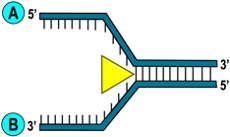
Below is a close-up of the portion of a DNA replication bubble. Helicase is shown as a yellow triangle currently moving from left to right. Based on what you know about the creation of new DNA during replication, which is the lagging strand and why?
A
A is the lagging strand, as DNA is always synthesized in the 5' to 3' manner.
B
B is the lagging strand, as DNA is always synthesized in the 5' to 3' manner.
C
A is the lagging strand, as DNA is always synthesized in the 3' to 5' manner.
D
B is the lagging strand, as DNA is always synthesized in the 3' to 5' manner.
E
It is impossible to tell, with the information provided.
3 Comments
Verified step by step guidance
1
Understand that DNA replication involves the synthesis of new DNA strands complementary to the original template strands.
Recognize that DNA polymerase can only add nucleotides in the 5' to 3' direction, which is crucial for determining the leading and lagging strands.
Identify the direction of the helicase movement, which is from left to right in the image, unwinding the DNA double helix.
Determine the orientation of the template strands: Strand A is 5' to 3' from left to right, and Strand B is 3' to 5' from left to right.
Conclude that Strand A is the lagging strand because the new DNA must be synthesized in short segments (Okazaki fragments) in the 5' to 3' direction, opposite to the direction of the replication fork movement.


 Verified step by step guidance

