Which of the following is not a mechanism of genetic transfer between cells?
a. Transduction b. Transformation c. Transcription d. Conjugation
Verified step by step guidance
1
Step 1: Understand the question is asking to identify which option is NOT a mechanism of genetic transfer between cells.
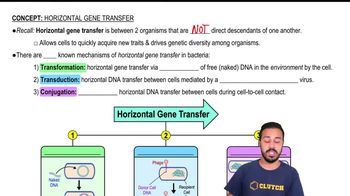
Step 2: Recall the definitions of each term: Transduction is the transfer of genetic material via bacteriophages (viruses that infect bacteria).
Step 3: Transformation is the uptake of free DNA from the environment by a bacterial cell.
Step 4: Conjugation is the direct transfer of DNA between two bacterial cells through a physical connection called a pilus.
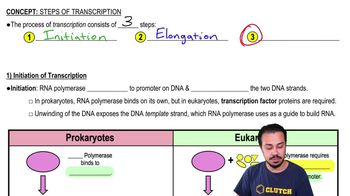
Step 5: Transcription is the process of copying DNA into RNA within a cell and is not a mechanism of genetic transfer between cells.
Verified video answer for a similar problem:
This video solution was recommended by our tutors as helpful for the problem above
Video duration:
2m
Play a video:
0 Comments
Key Concepts
Here are the essential concepts you must grasp in order to answer the question correctly.
Genetic Transfer Mechanisms in Bacteria
Genetic transfer in bacteria involves processes that move DNA between cells, enabling genetic diversity. The main mechanisms are transformation (uptake of free DNA), transduction (DNA transfer via bacteriophages), and conjugation (direct transfer through cell contact). These processes facilitate adaptation and evolution in microbial populations.
Transcription is the process by which RNA is synthesized from a DNA template within a single cell. It is not a mechanism of genetic transfer between cells but rather a step in gene expression, producing messenger RNA that guides protein synthesis.
Distinguishing Genetic Transfer from Gene Expression
Understanding the difference between genetic transfer and gene expression is crucial. Genetic transfer involves moving DNA between cells, while gene expression includes processes like transcription and translation that occur within a cell to produce proteins from genes.