In Griffith's classical experiments on transformation, which of the following scenarios led to a dead mouse? Select all that apply. a. Infecting the mouse with a living strain of S. pneumoniae that makes a capsule b. Infecting the mouse with a heat-killed strain of S. pneumoniae that makes a capsule c. Infecting the mouse with a heat-killed strain of S. pneumoniae that makes a capsule and a living strain of S. pneumoniae that cannot make a capsule d. Infecting the mouse with a living strain of S. pneumoniae that cannot make a capsule
Verified step by step guidance
1
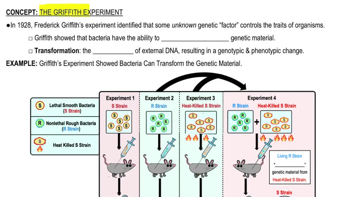
Step 1: Understand the key difference between the two strains of S. pneumoniae used in Griffith's experiment: the encapsulated (smooth, S) strain is virulent and causes death in mice, while the non-encapsulated (rough, R) strain is non-virulent and does not cause death.
Step 2: Analyze option (a): Infecting the mouse with a living encapsulated (S) strain. Since this strain is virulent due to its capsule, it will cause disease and lead to the death of the mouse.
Step 3: Analyze option (b): Infecting the mouse with a heat-killed encapsulated (S) strain. Heat-killed bacteria are not alive and cannot cause disease, so the mouse will survive.
Step 4: Analyze option (c): Infecting the mouse with a mixture of heat-killed encapsulated (S) strain and living non-encapsulated (R) strain. The heat-killed S strain can release genetic material that transforms the living R strain into a virulent form, causing the mouse to die.
Step 5: Analyze option (d): Infecting the mouse with a living non-encapsulated (R) strain. Since this strain lacks the capsule and is non-virulent, the mouse will survive.
Verified video answer for a similar problem:
This video solution was recommended by our tutors as helpful for the problem above
Video duration:
3m
Play a video:
0 Comments
Key Concepts
Here are the essential concepts you must grasp in order to answer the question correctly.
Griffith's Experiment and Bacterial Transformation
Griffith's experiment demonstrated that non-virulent bacteria could acquire virulence by taking up genetic material from heat-killed virulent bacteria. This process, called transformation, showed that DNA carries genetic information, allowing harmless bacteria to become deadly.
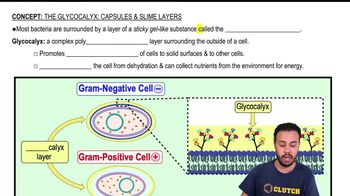
The capsule is a polysaccharide layer surrounding some bacteria, like S. pneumoniae, which protects them from the host immune system. Strains with capsules are virulent and cause disease, while those without capsules are typically non-virulent and do not kill the host.
Heat-Killed Bacteria and Their Effect on Infection
Heat-killed bacteria are dead and cannot cause infection by themselves. However, their genetic material can be taken up by living non-virulent bacteria, enabling transformation. In Griffith's experiment, only the combination of heat-killed virulent and live non-virulent bacteria led to a lethal infection.