a. Conjugation requires a sex pilus extending from the surface of a cell. b. Conjugation involves a C factor. c. Conjugation is an artificial genetic engineering technique. d. Conjugation involves DNA that has been released into the environment.
Verified step by step guidance
1
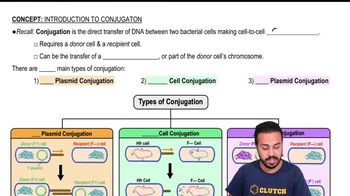
Step 1: Understand the process of bacterial conjugation. Conjugation is a natural mechanism of horizontal gene transfer between bacteria, where genetic material is transferred directly from one cell to another through physical contact.
Step 2: Analyze option (a): Conjugation requires a sex pilus extending from the surface of a donor cell. The sex pilus is a specialized appendage that facilitates the connection between donor and recipient cells during conjugation.
Step 3: Analyze option (b): Conjugation involves an F factor (fertility factor), which is a plasmid that carries genes necessary for pilus formation and DNA transfer. The term 'C factor' is incorrect in this context.
Step 4: Analyze option (c): Conjugation is a natural process, not an artificial genetic engineering technique. Artificial techniques include transformation and transduction or laboratory methods like recombinant DNA technology.
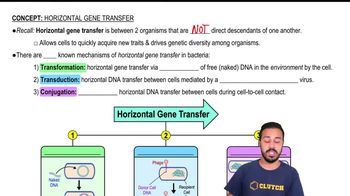
Step 5: Analyze option (d): DNA released into the environment is involved in transformation, not conjugation. Conjugation requires direct cell-to-cell contact, not free DNA uptake.
Verified video answer for a similar problem:
This video solution was recommended by our tutors as helpful for the problem above
Video duration:
2m
Play a video:
0 Comments
Key Concepts
Here are the essential concepts you must grasp in order to answer the question correctly.
Bacterial Conjugation
Bacterial conjugation is a natural process of horizontal gene transfer where genetic material is exchanged between bacterial cells through direct contact. It typically involves the formation of a sex pilus, which connects donor and recipient cells, allowing transfer of DNA such as plasmids.
The F factor is a plasmid that carries genes necessary for the formation of the sex pilus and initiation of conjugation. Cells possessing the F factor (F+) can transfer DNA to F- cells, making it essential for conjugation to occur.
Distinction Between Conjugation and Other Genetic Transfer Methods
Conjugation differs from transformation and transduction; it requires cell-to-cell contact and a sex pilus, unlike transformation which involves uptake of free DNA from the environment. It is a natural process, not an artificial genetic engineering technique.