In an immunodiffusion test, a strip of filter paper containing diphtheria antitoxin is placed on a solid culture medium. Then bacteria are streaked perpendicular to the filter paper. If the bacteria are toxigenic, a. The filter paper will turn red b. A line of antigen–antibody precipitate will form c. The cells will lyse d. The cells will fluoresce e. None of the above
Verified step by step guidance
1
Understand the principle of immunodiffusion tests: these tests detect the formation of antigen-antibody complexes by diffusion of antigens and antibodies in a gel or solid medium.
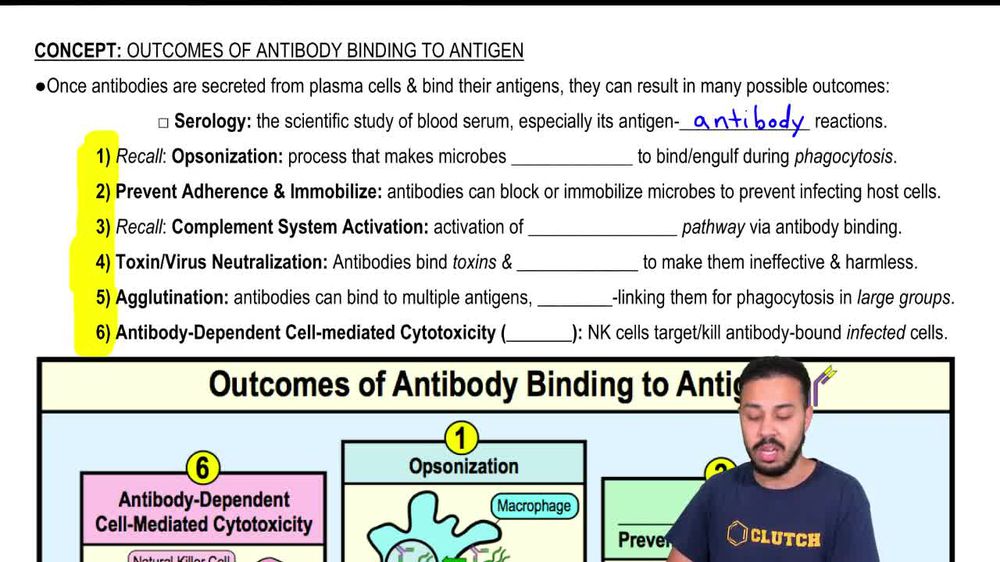
Recognize that diphtheria antitoxin contains antibodies specific to diphtheria toxin (the antigen). When toxigenic bacteria produce diphtheria toxin, this antigen diffuses into the medium.
As the diphtheria toxin (antigen) diffuses from the bacteria and the antitoxin (antibody) diffuses from the filter paper, they meet in the medium and form an antigen-antibody complex.
The formation of this complex results in a visible precipitate line in the medium, indicating a positive reaction for toxigenic bacteria.
Therefore, the expected observation is the formation of a line of antigen–antibody precipitate, corresponding to option b.
Verified video answer for a similar problem:
This video solution was recommended by our tutors as helpful for the problem above
Video duration:
2m
Play a video:
0 Comments
Key Concepts
Here are the essential concepts you must grasp in order to answer the question correctly.
Immunodiffusion Test
Immunodiffusion is a laboratory technique used to detect the presence of specific antigens or antibodies by their diffusion through a gel, forming a visible precipitate where they meet and react. It helps identify antigen-antibody interactions based on the formation of a precipitin line.
When an antigen and its specific antibody diffuse toward each other in a gel, they form a stable complex that precipitates out of solution, creating a visible line. This precipitate indicates a positive reaction, confirming the presence of the antigen or antibody.
Toxigenic bacteria produce toxins that can be neutralized by specific antitoxins. In the test, diphtheria antitoxin on the filter paper reacts with diphtheria toxin secreted by toxigenic bacteria, leading to antigen-antibody precipitation if the bacteria produce the toxin.

 2:34 minutes
 Verified step by step guidance
 06:59
06:59