Ch. 2 - Biochemistry Basics
Norman-McKay- Microbiology: Basic and Clinical Principles 2nd Edition
Norman-McKay2nd EditionMicrobiology: Basic and Clinical PrinciplesISBN: 9780137661619Not the one you use?Change textbook
Chapter 2, Problem 14

Which of the following is false?
a. ATP is used to fuel cellular work.
b. ATP is a specialized ribonucleotide.
c. Energy is released from ATP by breaking off phosphate groups.
d. ATP is used to fuel exergonic reactions.

Verified step by step guidance
1
Step 1: Understand the role of ATP in cellular processes. ATP (adenosine triphosphate) is the primary energy currency of the cell, used to fuel various types of cellular work such as mechanical, transport, and chemical work.
Step 2: Analyze each statement individually. Statement (a) says ATP is used to fuel cellular work, which is true because ATP provides energy for cellular activities.
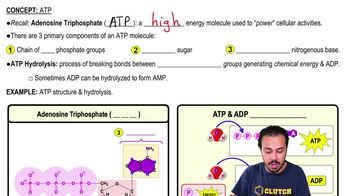
Step 3: Consider statement (b) that ATP is a specialized ribonucleotide. ATP is indeed a ribonucleotide composed of adenine, ribose (a sugar), and three phosphate groups, so this statement is true.
Step 4: Evaluate statement (c) about energy release from ATP by breaking off phosphate groups. Energy is released when ATP loses a phosphate group through hydrolysis, converting ATP to ADP or AMP, so this is true.
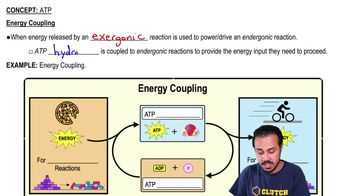
Step 5: Examine statement (d) that ATP is used to fuel exergonic reactions. Exergonic reactions release energy, so ATP is not used to fuel them; rather, ATP typically fuels endergonic (energy-requiring) reactions. Therefore, statement (d) is false.

Verified video answer for a similar problem:

This video solution was recommended by our tutors as helpful for the problem above.
Video duration:
2m
Was this helpful?

Key Concepts

Here are the essential concepts you must grasp in order to answer the question correctly.

Role of ATP in Cellular Work

ATP (adenosine triphosphate) serves as the primary energy currency in cells, providing energy to drive various cellular processes such as muscle contraction, active transport, and biosynthesis by transferring phosphate groups.
Recommended video:

Structure and Nature of ATP

ATP is a specialized ribonucleotide composed of adenine, ribose sugar, and three phosphate groups. It is a nucleotide derivative essential for energy transfer in biological systems.
Recommended video:

Energy Release from ATP Hydrolysis

Energy is released when ATP undergoes hydrolysis, breaking the bond between its phosphate groups, typically the terminal phosphate. This process releases energy used to power endergonic reactions, not exergonic ones.
Recommended video:
Guided course
04:57
Energy Coupling