
Ch. 14 - Principles of Disease and Epidemiology
Tortora - Microbiology: An Introduction 14th Edition
Tortora14th EditionMicrobiology: An IntroductionISBN: 9780138200398Not the one you use?Change textbook
Chapter 14, Problem 4

Which of the following is not one of Koch's postulates?
a. The same pathogen must be present in every case of the disease.
b. The pathogen must be isolated and grown in pure culture from the diseased host.
c. The pathogen from pure culture must cause the disease when inoculated into a healthy, susceptible laboratory animal.
d. The disease must be transmitted from a diseased animal to a healthy, susceptible animal by direct contact.
e. The pathogen must be isolated in pure culture from an experimentally infected lab animal.

Verified step by step guidance
1
Step 1: Recall Koch's postulates, which are a set of criteria established to link a specific microorganism to a specific disease. These postulates include: the pathogen must be found in all cases of the disease, it must be isolated and grown in pure culture, it must cause the disease when introduced into a healthy host, and it must be re-isolated from the experimentally infected host.
Step 2: Examine each option and compare it to the known Koch's postulates. Options a, b, c, and e align with the classical postulates: presence in every case, isolation in pure culture, causing disease in a healthy host, and re-isolation from the infected host.
Step 3: Identify option d, which states that the disease must be transmitted by direct contact from a diseased animal to a healthy one. This is not part of Koch's original postulates, as they do not specify the mode of transmission but focus on isolation and causation.
Step 4: Understand that Koch's postulates focus on establishing causality through isolation and infection, not on the mechanism of transmission such as direct contact.
Step 5: Conclude that option d is not one of Koch's postulates because it introduces a transmission method rather than a criterion for establishing the causative agent of disease.

Verified video answer for a similar problem:

This video solution was recommended by our tutors as helpful for the problem above.
Video duration:
2m
Was this helpful?

Key Concepts

Here are the essential concepts you must grasp in order to answer the question correctly.

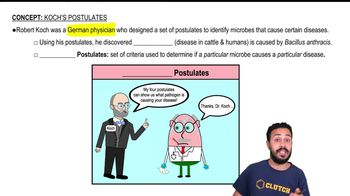
Koch's Postulates

Koch's postulates are a set of criteria established to link a specific microorganism to a particular disease. They require that the pathogen be found in all cases of the disease, isolated in pure culture, cause disease when introduced to a healthy host, and be re-isolated from the experimentally infected host.
Recommended video:
Guided course
01:36
Koch's Postulates

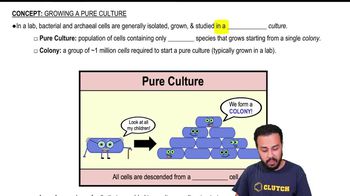
Pure Culture Isolation

Isolating a pathogen in pure culture means growing the microorganism alone without contamination from other species. This step is crucial to ensure that the disease-causing agent is correctly identified and studied without interference from other microbes.
Recommended video:
Guided course
02:58
Growing a Pure Culture

Disease Transmission and Experimental Infection

To prove causation, the isolated pathogen must cause the same disease when introduced into a healthy, susceptible host. This experimental infection confirms the pathogen's role in disease, and re-isolation from this host verifies the link between the microbe and the illness.
Recommended video:
Guided course
02:50
Experimental Design Example 1