Ch. 7 - The Control of Microbial Growth
Tortora - Microbiology: An Introduction 14th Edition
Tortora14th EditionMicrobiology: An IntroductionISBN: 9780138200398Not the one you use?Change textbook
Chapter 7, Problem 5

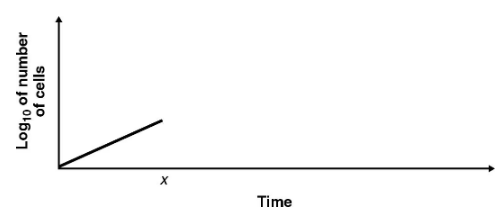
A bacterial culture was in log phase in the following figure. At time x, an antibacterial compound was added to the culture. Draw the lines indicating the addition of a bactericidal compound and a bacteriostatic compound. Explain why the viable count does not immediately drop to zero at x.
Graph showing bacterial cell count over time with a marked point where antibacterial agents are added.

Verified step by step guidance
1
Step 1: Understand the graph before time x. The graph shows a bacterial culture in the log phase, where the number of cells increases exponentially. This is represented by a straight line with a positive slope on a log scale, indicating rapid bacterial growth.
Step 2: At time x, an antibacterial compound is added. To represent the effect of a bacteriostatic compound, draw a horizontal line starting at time x. This indicates that the bacterial growth stops, so the number of viable cells remains constant over time, but cells are not killed.
Step 3: To represent the effect of a bactericidal compound, draw a line starting at time x that slopes downward on the log scale. This shows a decrease in the number of viable cells over time, as the compound kills bacteria, reducing the viable count.
Step 4: Explain why the viable count does not immediately drop to zero at time x. Even with a bactericidal compound, bacteria do not die instantaneously because the killing process takes time. Some cells may be in different physiological states, and the compound needs time to penetrate cells and disrupt vital processes.
Step 5: Summarize that the bacteriostatic compound halts growth without killing cells, resulting in a flat line, while the bactericidal compound reduces viable cells over time, shown by a downward slope. The delay in cell death explains why the viable count does not instantly fall to zero.

Verified video answer for a similar problem:

This video solution was recommended by our tutors as helpful for the problem above.
Video duration:
2m
Was this helpful?

Key Concepts

Here are the essential concepts you must grasp in order to answer the question correctly.

Bacterial Growth Phases

Bacterial growth occurs in distinct phases: lag, log (exponential), stationary, and death. The log phase is characterized by rapid cell division and exponential increase in cell number, which is crucial for understanding how bacteria respond to antibacterial agents added during this phase.
Recommended video:
Guided course
03:06
Bacterial Transformation

Bactericidal vs. Bacteriostatic Agents

Bactericidal agents kill bacteria, leading to a decline in viable cell count, while bacteriostatic agents inhibit bacterial growth without killing, causing the cell number to plateau. Differentiating these effects helps interpret changes in bacterial counts after treatment.
Recommended video:
Guided course
04:14
Liquid Chemicals: Surface-Active Agents

Viable Count and Delayed Effect of Antibacterials

Viable count measures living bacteria capable of reproduction. After adding an antibacterial, the count does not drop immediately due to factors like bacterial cell cycle stages, time needed for drug action, and presence of resistant or dormant cells, causing a lag before observable effects.
Recommended video:
Guided course
01:36
Measuring Growth by Plate Counts