
Ch. 1 - The Microbial World and You
Tortora - Microbiology: An Introduction 14th Edition
Tortora14th EditionMicrobiology: An IntroductionISBN: 9780138200398Not the one you use?Change textbook
Chapter 1, Problem 2

Briefly state the role microorganisms play in each of the following:
a. Biological control of pests
b. Recycling of elements
c. Normal microbiota
d. Sewage treatment
e. Human insulin production
f. Vaccine production
g. Biofilms

Verified step by step guidance
1
For each item, identify the specific role microorganisms play by considering their biological functions and applications in that context.
a. Biological control of pests: Explain how certain microorganisms act as natural enemies or pathogens to pest species, reducing their populations without harmful chemicals.
b. Recycling of elements: Describe how microorganisms decompose organic matter and participate in biogeochemical cycles (e.g., nitrogen, carbon, sulfur), facilitating nutrient recycling in ecosystems.
c. Normal microbiota: Discuss the role of microorganisms that naturally inhabit the human body, contributing to health by preventing pathogen colonization and aiding digestion.
d. Sewage treatment: Outline how microbes break down organic waste in sewage, reducing pollutants and producing safer effluent through processes like aerobic and anaerobic digestion.
e. Human insulin production: Explain the use of genetically engineered bacteria or yeast to produce human insulin via recombinant DNA technology for medical use.
f. Vaccine production: Describe how microorganisms or their components are used to develop vaccines that stimulate immunity against infectious diseases.
g. Biofilms: Define biofilms as communities of microorganisms attached to surfaces, highlighting their roles in protection, persistence, and sometimes causing infections or industrial issues.

Verified video answer for a similar problem:

This video solution was recommended by our tutors as helpful for the problem above.
Video duration:
2m
Was this helpful?

Key Concepts

Here are the essential concepts you must grasp in order to answer the question correctly.

Microorganisms in Environmental Processes

Microorganisms play a vital role in natural cycles by decomposing organic matter and recycling elements like carbon, nitrogen, and sulfur. They break down waste materials, facilitating nutrient availability for other organisms and maintaining ecosystem balance.
Recommended video:
Guided course
04:27
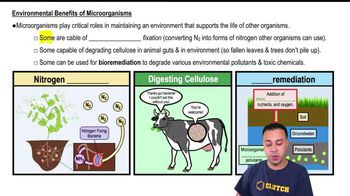
Environmental Benefits of Microorganisms

Microorganisms in Biotechnology and Medicine

Microbes are harnessed in biotechnology for producing human insulin, vaccines, and other pharmaceuticals. Genetic engineering allows bacteria or yeast to produce these substances efficiently, revolutionizing medical treatments and disease prevention.
Recommended video:
Guided course
01:25
Importance of Microorganisms

Microorganisms in Agriculture and Waste Management

Microbes contribute to biological pest control by targeting harmful pests, reducing chemical pesticide use. They also aid in sewage treatment by breaking down organic pollutants, and form biofilms that impact both natural and industrial environments.
Recommended video:
Guided course
01:25
Importance of Microorganisms