
Textbook Question
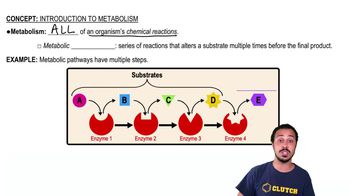
All of the energy-producing biochemical reactions that occur in cells, such as photophosphorylation and glycolysis, are ________ reactions.
1645
views

 Verified step by step guidance
 02:17
02:17
 02:59
02:59 02:00
02:00All of the energy-producing biochemical reactions that occur in cells, such as photophosphorylation and glycolysis, are ________ reactions.
Use the following choices to answer the question.
a. E. coli growing in glucose broth at 35℃ with O2 for 5 days
b. E. coli growing in glucose broth at 35℃ without O2 for 5 days
c. Both a and b
d. Neither a nor b
Which culture produces the most lactic acid?
Why must NADH be reoxidized? How does this happen in an organism that uses respiration? Fermentation?
Write your own definition of the chemiosmotic mechanism of ATP generation. On Figure 5.16, mark the following using the appropriate letter:
a. The acidic side of the membrane
b. The side with a positive electrical charge
c. Potential energy
d. Kinetic energy
Use the following choices to answer the question.
a. E. coli growing in glucose broth at 35℃ with O2 for 5 days
b. E. coli growing in glucose broth at 35℃ without O2 for 5 days
c. Both a and b
d. Neither a nor b
Which culture produces the most ATP?
Which of the following is the best definition of cellular respiration?
a. A sequence of redox reactions with O2 as the final electron acceptor
b. A sequence of redox reactions with the final electron acceptor from the environment
c. A method of generating ATP
d. The complete oxidation of glucose to CO2 and H2O
e. A series of reactions in which pyruvic acid is oxidized to CO2 and H2O