
Ch. 1 - The Microbial World and You
Tortora - Microbiology: An Introduction 14th Edition
Tortora14th EditionMicrobiology: An IntroductionISBN: 9780138200398Not the one you use?Change textbook
Chapter 1, Problem 2

Which of the following is not a characteristic of bacteria?
a. Are prokaryotic
b. Have peptidoglycan cell walls
c. Have the same shape
d. Grow by binary fission
e. Have the ability to move

Verified step by step guidance
1
Step 1: Understand the characteristics of bacteria. Bacteria are unicellular prokaryotic organisms, meaning they lack a true nucleus and membrane-bound organelles.
Step 2: Review each option in the question to determine if it correctly describes bacteria:
Step 3: Option a states bacteria are prokaryotic, which is true because bacteria do not have a nucleus.
Step 4: Option b states bacteria have peptidoglycan cell walls, which is true as peptidoglycan is a major component of bacterial cell walls.
Step 5: Option c states bacteria have the same shape, which is incorrect because bacteria exhibit a variety of shapes such as cocci (spherical), bacilli (rod-shaped), and spirilla (spiral-shaped).

Verified video answer for a similar problem:

This video solution was recommended by our tutors as helpful for the problem above.
Video duration:
2m
Was this helpful?

Key Concepts

Here are the essential concepts you must grasp in order to answer the question correctly.

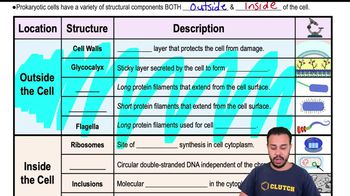
Prokaryotic Cell Structure

Bacteria are prokaryotes, meaning they lack a nucleus and membrane-bound organelles. Their genetic material is found in a nucleoid region, and their cellular processes occur in the cytoplasm, distinguishing them from eukaryotic cells.
Recommended video:
Guided course
05:59
Overview of Prokaryotic Cell Structure

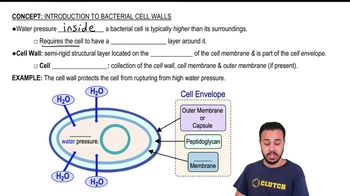
Bacterial Cell Wall Composition

Most bacteria have cell walls made of peptidoglycan, a polymer that provides structural support and shape. This feature is unique to bacteria and helps protect them from environmental stress and osmotic pressure.
Recommended video:
Guided course
03:44
Introduction to Bacterial Cell Walls

Bacterial Morphology and Reproduction

Bacteria exhibit diverse shapes such as rods, spheres, and spirals, so they do not have the same shape. They reproduce asexually through binary fission, a process where one cell divides into two identical daughter cells, and many can move using structures like flagella.
Recommended video:
Guided course
02:44
Types of Bacterial Cell Morphology