Ch. 9 - Biotechnology & DNA Technology
Tortora - Microbiology: An Introduction 14th Edition
Tortora14th EditionMicrobiology: An IntroductionISBN: 9780138200398Not the one you use?Change textbook
Chapter 9, Problem 5

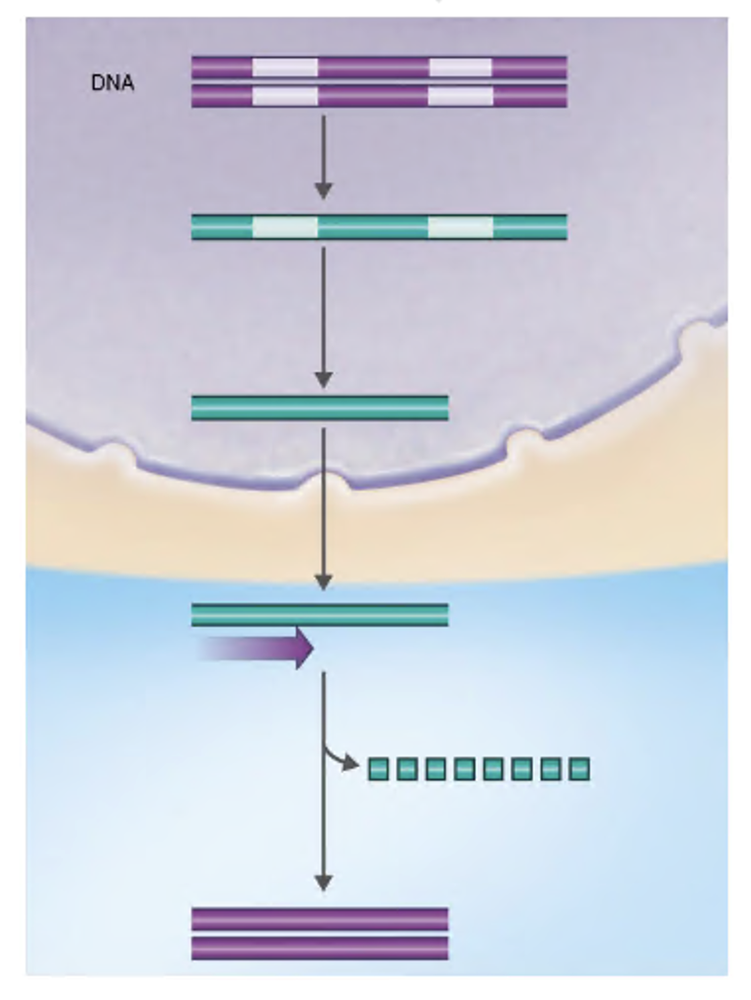
Identify and mark each of the following in making cDNA: transcription, RNA processing, reverse transcription, DNA polymerase, cDNA.
Diagram showing the process of making cDNA from DNA through transcription, RNA processing, reverse transcription, and DNA polymerase action.

Verified step by step guidance
1
Step 1: Understand the process of making cDNA (complementary DNA). It involves starting from an mRNA template and converting it back into DNA. The key stages include transcription, RNA processing, reverse transcription, and DNA synthesis.
Step 2: Identify 'transcription' as the process where DNA is used to make pre-mRNA. This occurs in the nucleus and involves RNA polymerase synthesizing RNA complementary to the DNA template strand.
Step 3: Mark 'RNA processing' as the modifications that pre-mRNA undergoes to become mature mRNA. This includes 5' capping, splicing out introns, and 3' polyadenylation, preparing the mRNA for export to the cytoplasm.
Step 4: Locate 'reverse transcription' as the step where the enzyme reverse transcriptase synthesizes cDNA from the mature mRNA template. This is the key step that converts RNA back into DNA.
Step 5: Identify 'DNA polymerase' as the enzyme that may be used to synthesize the second strand of DNA, creating double-stranded cDNA from the single-stranded cDNA produced by reverse transcriptase.

Verified video answer for a similar problem:

This video solution was recommended by our tutors as helpful for the problem above.
Video duration:
1m
Was this helpful?

Key Concepts

Here are the essential concepts you must grasp in order to answer the question correctly.

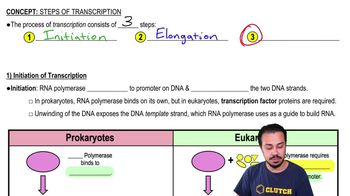
Transcription

Transcription is the process where RNA is synthesized from a DNA template by RNA polymerase. It produces a primary RNA transcript that contains both exons and introns before any processing occurs.
Recommended video:
Guided course
04:16
Initiation of Transcription

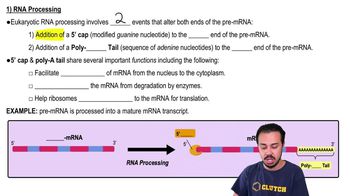
RNA Processing

RNA processing modifies the primary RNA transcript into mature mRNA by splicing out introns, adding a 5' cap, and a 3' poly-A tail. This processed mRNA is then ready for translation or reverse transcription.
Recommended video:
Guided course
04:19
1) RNA Processing

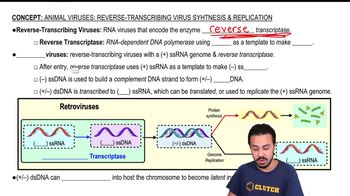
Reverse Transcription and cDNA Synthesis

Reverse transcription uses reverse transcriptase to synthesize complementary DNA (cDNA) from processed mRNA. DNA polymerase can then be used to create double-stranded cDNA, which is essential for cloning or PCR applications.
Recommended video:
Guided course
04:28
Animal Viruses: Reverse-Transcribing Virus Synthesis & Replication