
Textbook Question
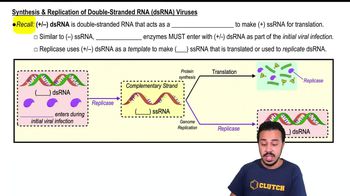
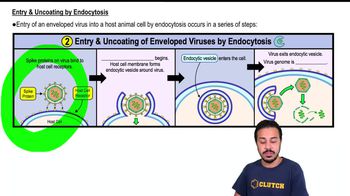
Compare biosynthesis of a + stranded RNA and a - stranded RNA virus.
1341
views


 Verified step by step guidance
 04:28
04:28
 02:29 04:28
Compare biosynthesis of a + stranded RNA and a - stranded RNA virus.
Describe the four morphological classes of viruses, then diagram and give an example of each.
Which of the following would be the first step in the biosynthesis of a virus with reverse transcriptase?
a. A complementary strand of RNA must be synthesized.
b. Double-stranded RNA must be synthesized.
c. A complementary strand of DNA must be synthesized from an RNA template.
d. A complementary strand of DNA must be synthesized from a DNA template.
e. None of the above
An example of lysogeny in animals could be
a. slow viral infections.
b. latent viral infections.
c. T-even bacteriophages.
d. infections resulting in cell death.
e. none of the above
A virus with RNA-dependent RNA polymerase
a. synthesizes DNA from an RNA template.
b. synthesizes double-stranded RNA from an RNA template.
c. synthesizes double-stranded RNA from a DNA template.
d. transcribes mRNA from DNA.
e. none of the above
Some antibiotics activate phage genes. MRSA releasing Panton-Valentine leukocidin is a toxin that can cause a life-threatening disease. Why can such a disease develop following antibiotic treatment?