
Textbook Question
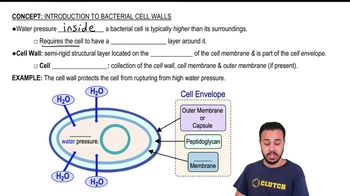
Which cellular structure is important in classifying a bacterial species as Gram positive or Gram negative?
a. Flagella
b. Cell wall
c. Cilia
d. Glycocalyx
924
views

 Verified step by step guidance
 05:54
05:54
 03:44
03:44 05:58
05:58Which cellular structure is important in classifying a bacterial species as Gram positive or Gram negative?
a. Flagella
b. Cell wall
c. Cilia
d. Glycocalyx
Which of the following is not a function of a glycocalyx?
a. It forms pseudopods for faster mobility of an organism.
b. It can protect a bacterial cell from drying out.
c. It hides a bacterial cell from other cells.
d. It allows a bacterium to stick to a host.
Differentiate among pili, fimbriae, and cilia, using sketches and descriptive labels.
Bacterial flagella are __________ .
a. anchored to the cell by a basal body
b. composed of hami
c. surrounded by an extension of the cytoplasmic membrane
d. composed of tubulin in hollow microtubules in a "9 + 2" arrangement
Compare bacterial cells and algal cells, giving at least four similarities and four differences.
Which of the following statements is true?
a. The cell walls of bacteria are composed of peptidoglycan.
b. Peptidoglycan is a fatty acid.
c. Gram-positive bacterial walls have a relatively thin layer of peptidoglycan anchored to the cytoplasmic membrane by teichoic acids.
d. Peptidoglycan is found mainly in the cell walls of fungi, algae, and plants.