Ch. 15 - Antimicrobial Drugs
Norman-McKay- Microbiology: Basic and Clinical Principles 2nd Edition
Norman-McKay2nd EditionMicrobiology: Basic and Clinical PrinciplesISBN: 9780137661619Not the one you use?Change textbook
Chapter 15, Problem 11

Assume a clinical sample yields a strain of S. aureus containing a plasmid that encodes two antimicrobial-resistance genes. How did the bacterium most likely acquire these new resistance genes?
a. The strain was intrinsically resistant.
b. The strain obtained the genes through horizontal gene transfer.
c. The strain acquired the genes by a random mutation.
d. The strain picked up the genes by an efflux pump.
e. The strain acquired the genes through cell division events.

Verified step by step guidance
1
Step 1: Understand the context of the problem. The question involves a strain of Staphylococcus aureus that has acquired two antimicrobial-resistance genes located on a plasmid. Plasmids are extrachromosomal DNA elements that can carry genes, including those for antibiotic resistance.
Step 2: Review the mechanisms by which bacteria can acquire new genetic material. These include intrinsic resistance (natural, inherent traits), mutations (random changes in the bacterial chromosome), horizontal gene transfer (transfer of genetic material between bacteria), and other mechanisms like efflux pumps (which expel antibiotics but do not acquire new genes).
Step 3: Recognize that intrinsic resistance (option a) refers to natural resistance without gene acquisition, so it does not explain new resistance genes on a plasmid.
Step 4: Understand that random mutations (option c) typically affect chromosomal DNA and usually do not result in the acquisition of multiple resistance genes on a plasmid.
Step 5: Identify horizontal gene transfer (option b) as the process by which bacteria can acquire plasmids carrying resistance genes from other bacteria, making it the most likely mechanism for acquiring new resistance genes encoded on a plasmid.

Verified video answer for a similar problem:

This video solution was recommended by our tutors as helpful for the problem above.
Video duration:
2m
Was this helpful?

Key Concepts

Here are the essential concepts you must grasp in order to answer the question correctly.

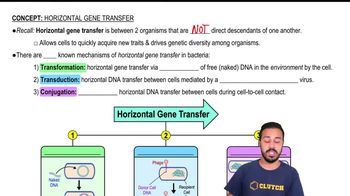
Horizontal Gene Transfer

Horizontal gene transfer (HGT) is the movement of genetic material between bacteria through mechanisms like conjugation, transformation, or transduction. It allows bacteria to rapidly acquire new traits, such as antibiotic resistance, by obtaining genes from other organisms rather than inheriting them from parent cells.
Recommended video:
Guided course
04:42
Horizontal Gene Transfer

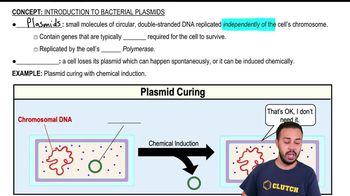
Plasmids and Antimicrobial Resistance Genes

Plasmids are small, circular DNA molecules separate from the bacterial chromosome that often carry genes beneficial for survival, including antimicrobial resistance genes. These plasmids can be transferred between bacteria, spreading resistance traits across populations.
Recommended video:
Guided course
02:52
Introduction to Bacterial Plasmids

Intrinsic Resistance vs. Acquired Resistance

Intrinsic resistance refers to the natural, inherent ability of a bacterial species to resist certain antibiotics, while acquired resistance arises from genetic changes like mutations or gene acquisition. In this case, the presence of resistance genes on a plasmid indicates acquired resistance rather than intrinsic.
Recommended video:
Guided course
06:20
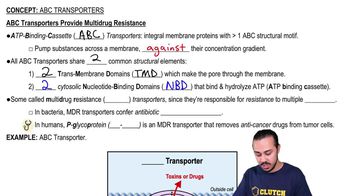
ABC Transporters Provide Multidrug Resistance
Related Practice
Textbook Question

Which of the following antimicrobial properties would be the most crucial to consider in developing a new antimicrobial?

a. Selective toxicity

b. Ease of administration

c. Lack of drug interactions

d. Long half-life

e. The drug’s capacity to be bactericidal

736
views
Textbook Question

Assume a bacterium makes beta-lactamase. Could you still use a glycopeptide drug to treat an infection caused by this bacterium? Explain your reasoning.

725
views
Textbook Question

Mark the following as true or false, and then correct the false statements so they are true.

a. Human cells make drug efflux pumps.

b. The minimum bactericidal concentration is the minimum concentration of the drug that kills at least 50 percent of the bacteria present.

c. The E-test can reveal if a drug is bactericidal or bacteriostatic.

d. A drug that is bactericidal at one dose may be bacteriostatic at another dose.

e. The antifolate combination therapy trimethoprim-sulfamethoxazole may be used to treat protozoan infections.

766
views
Textbook Question

Acquired antibiotic resistance can include all of the following except:

a. Altering an enzyme that a given drug may target

b. Making endospores

c. Altering a point of entry for a drug

d. Making enzymes that inactivate a drug

e. Increasing the number of efflux pumps that are active in a cell

1401
views
Textbook Question

The difference between a synthetic drug and a semisynthetic drug is that

a. the semisynthetic drug is a modified synthetic drug.

b. the synthetic drug is a modified natural drug.

c. the synthetic drug is a modified semisynthetic drug.

d. the semisynthetic drug is a modified natural drug.

187
views
Textbook Question

If a gene encoding a bacterial transpeptidase enzyme undergoes mutation, which of the following antimicrobials may no longer be effective against the mutated bacterium?

a. Macrolides

b. Polypeptide drugs

c. Tetracyclines

d. Penicillins

e. Quinolones

754
views