Ch. 3 - Introduction to Prokaryotic Cells
Norman-McKay- Microbiology: Basic and Clinical Principles 2nd Edition
Norman-McKay2nd EditionMicrobiology: Basic and Clinical PrinciplesISBN: 9780137661619Not the one you use?Change textbook
Chapter 3, Problem 4

Indicate the true statements about prokaryotic cells, and then reword the false statements so that they are true.
a. They have 80S ribosomes.
b. They sexually reproduce by meiosis.
c. Cell walls underlie the plasma membrane.
d. They synthesize proteins with the help of ribosomes.
e. They can store nutrients in inclusion bodies.
f. Fimbriae are used for motility.
g. Archaea and Bacteria can be classified using the Gram stain.

Verified step by step guidance
1
Step 1: Evaluate statement (a): "They have 80S ribosomes." Understand that prokaryotic cells have 70S ribosomes, not 80S, which are characteristic of eukaryotic cells. So, this statement is false and should be reworded to: "They have 70S ribosomes."
Step 2: Evaluate statement (b): "They sexually reproduce by meiosis." Recognize that prokaryotes reproduce asexually, primarily by binary fission, and do not undergo meiosis. Reword the statement to: "They reproduce asexually by binary fission."
Step 3: Evaluate statement (c): "Cell walls underlie the plasma membrane." Recall the cell structure of prokaryotes where the plasma membrane lies beneath the cell wall, so this statement is true.
Step 4: Evaluate statement (d): "They synthesize proteins with the help of ribosomes." Since ribosomes are essential for protein synthesis in all cells, this statement is true for prokaryotes.
Step 5: Evaluate statement (e): "They can store nutrients in inclusion bodies." Inclusion bodies are indeed storage sites within prokaryotic cells, so this statement is true.

Verified video answer for a similar problem:

This video solution was recommended by our tutors as helpful for the problem above.
Video duration:
3m
Was this helpful?

Key Concepts

Here are the essential concepts you must grasp in order to answer the question correctly.

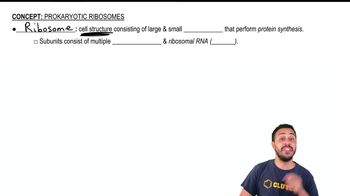
Prokaryotic Ribosomes

Prokaryotic cells contain 70S ribosomes, which are smaller than the 80S ribosomes found in eukaryotic cells. These ribosomes are essential for protein synthesis and differ in size and structure, allowing antibiotics to target bacterial ribosomes without affecting eukaryotic ones.
Recommended video:
Guided course
01:51
Prokaryotic Ribosomes

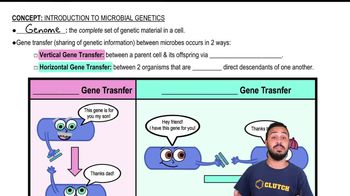
Prokaryotic Reproduction and Genetic Exchange

Prokaryotes reproduce asexually through binary fission, not meiosis, which is a process of sexual reproduction in eukaryotes. However, prokaryotes can exchange genetic material via processes like conjugation, transformation, and transduction, contributing to genetic diversity.
Recommended video:
Guided course
04:20
Introduction to Microbial Genetics

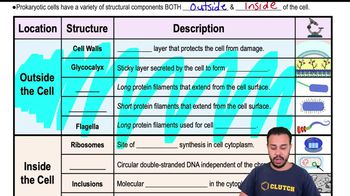
Cell Structure and Functions in Prokaryotes

Prokaryotic cells have a plasma membrane covered externally by a cell wall, which provides shape and protection. They can store nutrients in inclusion bodies, use ribosomes for protein synthesis, and have fimbriae primarily for attachment, not motility. Gram staining differentiates bacteria based on cell wall properties, but archaea do not respond predictably to this stain.
Recommended video:
Guided course
05:59
Overview of Prokaryotic Cell Structure