Which of the following statements is false? a. Viruses may have circular DNA. b. dsRNA is found in bacteria more often than in viruses. c. Viral DNA may be linear. d. Typically, viruses have DNA or RNA but not both.
Verified step by step guidance
1
Step 1: Understand the nature of viral genomes. Viruses can have DNA or RNA as their genetic material, and this can be either single-stranded or double-stranded. Additionally, viral DNA can be either circular or linear.
Step 2: Analyze statement (a): 'Viruses may have circular DNA.' This is true because some viruses, such as certain bacteriophages and animal viruses, have circular DNA genomes.
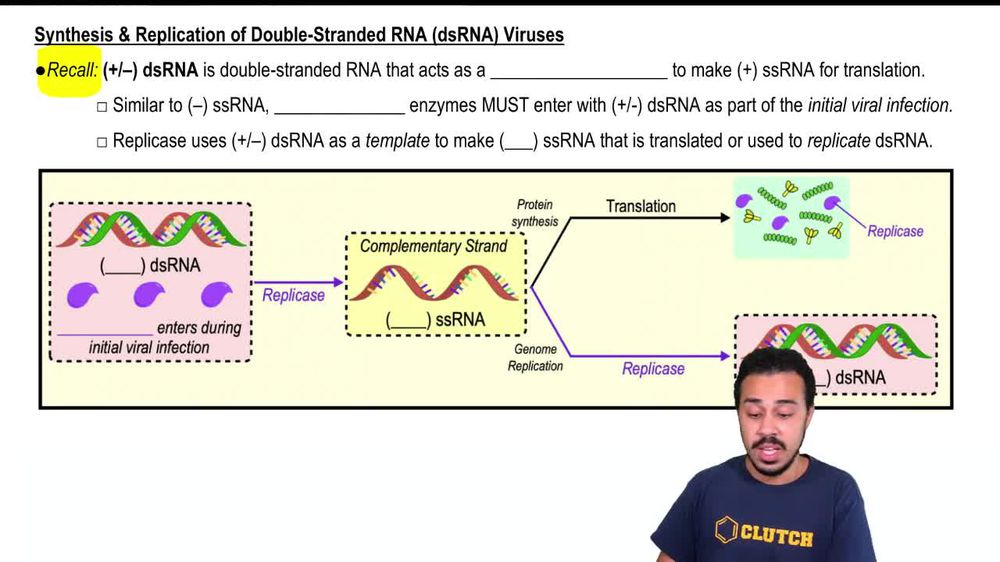
Step 3: Analyze statement (b): 'dsRNA is found in bacteria more often than in viruses.' This requires understanding that double-stranded RNA (dsRNA) genomes are characteristic of some viruses, but dsRNA is not commonly found in bacteria. Bacteria typically have double-stranded DNA genomes, not dsRNA.
Step 4: Analyze statement (c): 'Viral DNA may be linear.' This is true because many viruses, including some bacteriophages and animal viruses, have linear DNA genomes.
Step 5: Analyze statement (d): 'Typically, viruses have DNA or RNA but not both.' This is true; viruses generally contain either DNA or RNA as their genetic material, but not both simultaneously.
Verified video answer for a similar problem:
This video solution was recommended by our tutors as helpful for the problem above
Video duration:
1m
Play a video:
0 Comments
Key Concepts
Here are the essential concepts you must grasp in order to answer the question correctly.
Viral Genome Structure
Viruses can have genomes made of DNA or RNA, which may be single-stranded or double-stranded, and can be linear or circular. Understanding the diversity in viral genome structures helps in identifying viral types and their replication mechanisms.
Double-stranded RNA is uncommon in bacteria but is a characteristic feature of some viruses. Most bacteria have double-stranded DNA genomes, while dsRNA viruses use this form as their genetic material, making dsRNA more typical in viruses than bacteria.
Viruses typically contain either DNA or RNA as their genetic material, but not both simultaneously. This exclusivity is a fundamental principle in virology, distinguishing viral types and influencing their replication strategies.

 1:59 minutes
 Verified step by step guidance
 03:18
03:18