Ch. 1 - Introduction to Microbiology
Norman-McKay- Microbiology: Basic and Clinical Principles 2nd Edition
Norman-McKay2nd EditionMicrobiology: Basic and Clinical PrinciplesISBN: 9780137661619Not the one you use?Change textbook
Chapter 1, Problem 21

Which of the following is true?
a. SEM is higher resolution than TEM.
b. Most viruses can be seen using a light microscope.
c. Simple staining involves an acidic and a basic dye in combination.
d. Samples can be stained or unstained for light microscopy.
e. These are all false statements.

Verified step by step guidance
1
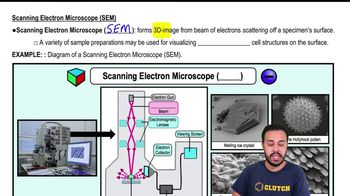
Step 1: Understand the difference between SEM (Scanning Electron Microscope) and TEM (Transmission Electron Microscope). SEM provides detailed 3D surface images, while TEM offers higher resolution images of internal structures. So, compare their resolution capabilities.
Step 2: Recall the size range of viruses and the resolving power of light microscopes. Light microscopes typically cannot resolve objects smaller than about 200 nanometers, while most viruses are smaller than this limit.
Step 3: Review the concept of simple staining in microbiology. Simple staining usually involves the use of a single basic dye to color cells, not a combination of acidic and basic dyes.
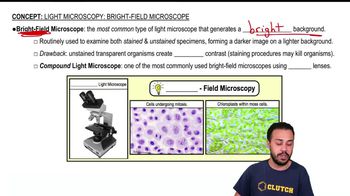
Step 4: Consider the types of samples used in light microscopy. Samples can indeed be either stained to enhance contrast or unstained (live or transparent samples) depending on the technique and purpose.
Step 5: Based on the analysis of each statement, determine which one is true by eliminating the false ones.

Verified video answer for a similar problem:

This video solution was recommended by our tutors as helpful for the problem above.
Video duration:
2m
Was this helpful?

Key Concepts

Here are the essential concepts you must grasp in order to answer the question correctly.

Electron Microscopy: SEM vs TEM

Scanning Electron Microscopy (SEM) provides detailed 3D surface images but generally has lower resolution than Transmission Electron Microscopy (TEM), which offers higher resolution images of internal structures by transmitting electrons through thin samples.
Recommended video:
Guided course
02:54
Scanning Electron Microscope (SEM)

Microscopy of Viruses

Most viruses are too small to be seen with a light microscope due to their size being below the resolution limit (~200 nm). Electron microscopes are required to visualize viruses clearly.
Recommended video:
Guided course
03:46
Light Microscopy: Bright-Field Microscopes

Staining Techniques in Light Microscopy

Simple staining uses a single basic dye to color cells, enhancing contrast. Differential staining involves multiple dyes, including acidic and basic, but simple staining does not combine both types. Samples can be observed stained or unstained under light microscopy.
Recommended video:
Guided course
03:46
Light Microscopy: Bright-Field Microscopes