
Ch. 7 - Microbial Genetics
Bauman - Microbiology with Diseases by Taxonomy 6th Edition
Bauman6th EditionMicrobiology with Diseases by TaxonomyISBN: 9780134832302Not the one you use?Change textbook
Chapter 7, Problem 15

Although two cells are totally unrelated, one cell receives DNA from the other cell and incorporates this new DNA into its chromosome. This process is ___________.


a. crossing over of DNA from the two cells
b. vertical gene transfer
c. horizontal gene transfer
d. transposition

Verified step by step guidance
1
Step 1: Understand the scenario described: one cell receives DNA from another, unrelated cell and incorporates it into its chromosome.
Step 2: Recall the definitions of the options: Vertical gene transfer is the passing of genetic material from parent to offspring; horizontal gene transfer is the transfer of genetic material between unrelated cells; crossing over involves exchange of DNA between homologous chromosomes during meiosis; transposition involves movement of DNA segments within the same genome.
Step 3: Since the DNA transfer occurs between unrelated cells (not parent to offspring), eliminate vertical gene transfer.
Step 4: Since the DNA is incorporated into the recipient cell's chromosome from another cell, this matches the definition of horizontal gene transfer.
Step 5: Conclude that the process described is horizontal gene transfer.

Verified video answer for a similar problem:

This video solution was recommended by our tutors as helpful for the problem above.
Video duration:
2m
Was this helpful?

Key Concepts

Here are the essential concepts you must grasp in order to answer the question correctly.

Horizontal Gene Transfer

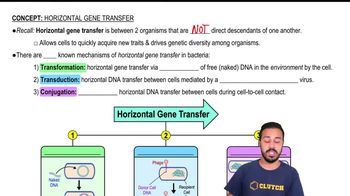
Horizontal gene transfer is the movement of genetic material between organisms that are not parent and offspring. It allows unrelated cells to exchange DNA, leading to genetic diversity and adaptation, commonly seen in bacteria through transformation, transduction, or conjugation.
Recommended video:
Guided course
04:42
Horizontal Gene Transfer

Vertical Gene Transfer

Vertical gene transfer is the transmission of genetic material from parent to offspring during reproduction. It represents the traditional inheritance pathway, where DNA is passed down through generations within a lineage.
Recommended video:
Guided course
04:42
Horizontal Gene Transfer

Transposition

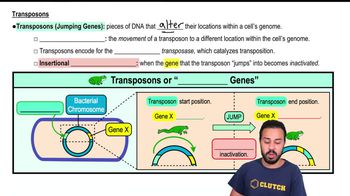
Transposition involves the movement of specific DNA sequences called transposons within the genome of a single organism. These 'jumping genes' can change position but do not typically transfer DNA between unrelated cells.
Recommended video:
Guided course
04:19
Transposons in Prokaryotes