

Contrast lysis and budding as means of release of virions from a host cell.
Verified step by step guidance
1
Begin by defining lysis as a process where the host cell membrane is disrupted or broken down, leading to the release of newly formed virions by causing the cell to burst open.
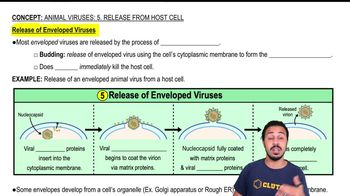
Explain budding as a process where virions exit the host cell by acquiring a portion of the host's membrane, which wraps around the virion, allowing it to leave the cell without immediately destroying it.
Highlight that lysis typically results in the death of the host cell, whereas budding allows the host cell to survive for some time and continue producing more virions.
Discuss the types of viruses that commonly use each method: many non-enveloped viruses use lysis, while enveloped viruses often use budding to acquire their lipid envelope.
Summarize the key differences by comparing the impact on the host cell, the presence or absence of an envelope on the virion, and the mechanism of membrane involvement during virion release.
Verified video answer for a similar problem:
This video solution was recommended by our tutors as helpful for the problem above
Video duration:
2m
Play a video:
0 Comments
Key Concepts
Here are the essential concepts you must grasp in order to answer the question correctly.
Lysis as a Viral Release Mechanism
Lysis is the process where the host cell membrane is ruptured, causing the cell to burst and release newly formed virions. This method typically results in the death of the host cell and is common among non-enveloped viruses.
Budding involves the virus acquiring its envelope by pushing through the host cell membrane, allowing virions to exit without immediately destroying the cell. This process is typical of enveloped viruses and allows the host cell to survive longer.
The main difference lies in host cell fate and viral envelope acquisition: lysis destroys the cell and releases non-enveloped viruses, while budding preserves the cell and produces enveloped viruses. These mechanisms reflect different viral strategies for propagation.