Ch. 11 - The Prokaryotes: Domains Bacteria and Archaea
Tortora - Microbiology: An Introduction 14th Edition
Tortora14th EditionMicrobiology: An IntroductionISBN: 9780138200398Not the one you use?Change textbook
Chapter 11, Problem 1

If you Gram-stained the bacteria that live in the human intestine, you would expect to find mostly
a. gram-positive cocci.
b. gram-negative rods.
c. gram-positive, endospore-forming rods.
d. gram-negative, nitrogen-fixing bacteria.
e. all of the above.

Verified step by step guidance
1
Step 1: Understand the Gram stain and bacterial morphology terms. Gram-positive bacteria retain the crystal violet stain and appear purple, while Gram-negative bacteria do not and appear pink/red. Cocci are spherical bacteria, rods are cylindrical, and endospore-forming rods are a specific group of Gram-positive bacteria capable of forming spores.
Step 2: Recall the typical bacterial composition of the human intestine. The gut microbiota is dominated by certain groups of bacteria, primarily from the phyla Bacteroidetes and Firmicutes.
Step 3: Identify the Gram reaction and shape of the dominant intestinal bacteria. Bacteroidetes are mostly Gram-negative rods, while Firmicutes include many Gram-positive rods and cocci, but many Firmicutes in the gut are not endospore-forming.
Step 4: Evaluate the options given: (a) gram-positive cocci, (b) gram-negative rods, (c) gram-positive, endospore-forming rods, (d) gram-negative, nitrogen-fixing bacteria, and (e) all of the above. Consider which group is most abundant in the human intestine.
Step 5: Conclude that since the majority of gut bacteria are Gram-negative rods (such as Bacteroides species), the best answer corresponds to option (b).

Verified video answer for a similar problem:

This video solution was recommended by our tutors as helpful for the problem above.
Video duration:
1m
Was this helpful?

Key Concepts

Here are the essential concepts you must grasp in order to answer the question correctly.

Gram Staining and Bacterial Cell Wall Structure

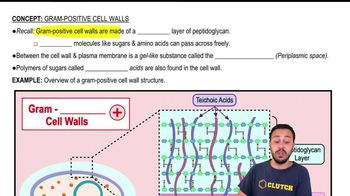
Gram staining differentiates bacteria based on their cell wall composition. Gram-positive bacteria have thick peptidoglycan layers that retain the crystal violet stain, appearing purple, while gram-negative bacteria have thinner peptidoglycan and an outer membrane, appearing pink after counterstaining.
Recommended video:
Guided course
02:59
Gram-Positive Cell Walls

Common Bacterial Morphologies in the Human Intestine

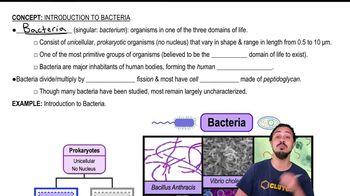
The human intestine predominantly harbors gram-negative rods, such as Escherichia coli and Bacteroides species. These bacteria play key roles in digestion and maintaining gut health, contrasting with less common gram-positive cocci or endospore-forming rods in this environment.
Recommended video:
Guided course
02:44
Types of Bacterial Cell Morphology

Role of Nitrogen-Fixing Bacteria and Their Typical Habitats

Nitrogen-fixing bacteria convert atmospheric nitrogen into usable forms but are mostly found in soil or plant root nodules, not the human intestine. Thus, gram-negative nitrogen-fixing bacteria are unlikely to be predominant in the gut microbiota.
Recommended video:
Guided course
06:18
Introduction to Bacteria