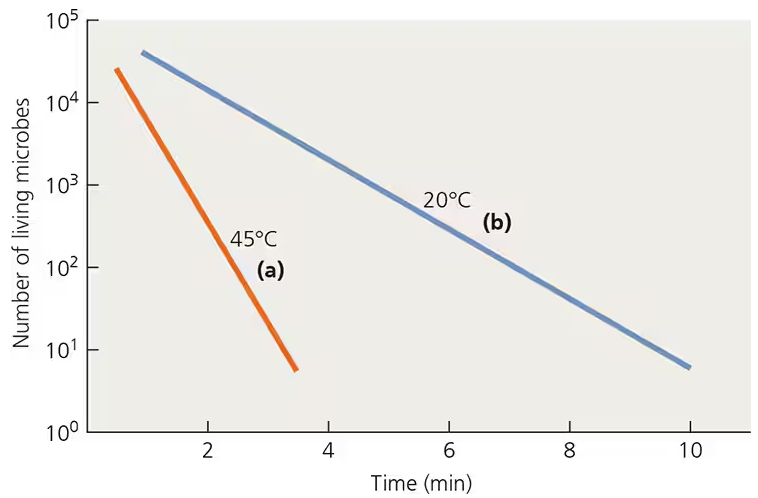
Calculate the decimal reduction time (D) for the two temperatures in the following graph.
Verified step by step guidance
1
Identify the decimal reduction time (D) definition: it is the time required at a certain temperature to reduce the number of living microbes by 90%, which corresponds to a 1-log reduction on a logarithmic scale.
On the graph, locate the initial number of living microbes for each temperature (45°C and 20°C) at the starting time point.
For each temperature, find the time it takes for the number of living microbes to decrease by one logarithmic unit (i.e., from 10^4 to 10^3, or from 10^3 to 10^2, etc.). This time interval corresponds to the decimal reduction time (D).
Calculate the difference in time between these two points on the x-axis (time in minutes) for each temperature curve. This difference is the decimal reduction time (D) for that temperature.
Repeat the process for both the 45°C and 20°C curves to find their respective D values, noting that the steeper slope (45°C) will have a smaller D value compared to the gentler slope (20°C).
Verified video answer for a similar problem:
This video solution was recommended by our tutors as helpful for the problem above
Video duration:
1m
Play a video:
0 Comments
Key Concepts
Here are the essential concepts you must grasp in order to answer the question correctly.
Decimal Reduction Time (D-value)
The decimal reduction time (D-value) is the time required at a specific temperature to reduce the microbial population by 90%, or one log cycle. It is a key measure of microbial resistance to heat and is used to compare the effectiveness of different temperatures in killing microbes.
Microbial death over time is often plotted on a logarithmic scale to linearize the exponential decline in the number of living microbes. This allows easier calculation of the D-value by measuring the time interval for a one-log reduction in microbial count.
Higher temperatures generally increase the rate of microbial death, resulting in a shorter D-value. The graph shows two temperatures (20°C and 45°C), illustrating that microbes die faster at 45°C compared to 20°C, which is reflected in the steeper slope of the 45°C line.