Being habitually careful not to touch or rub your eyes with unwashed hands would reduce your risk of contracting_____. a. chickenpox b. infectious mononucleosis c. seed warts d. a cold
Verified step by step guidance
1
Step 1: Understand the mode of transmission for each disease listed in the options.
Step 2: Recognize that touching or rubbing your eyes with unwashed hands primarily risks introducing pathogens that cause respiratory infections or infections transmitted via mucous membranes.
Step 3: Identify that chickenpox is mainly transmitted through airborne droplets, infectious mononucleosis through saliva, seed warts through direct skin contact, and the common cold through respiratory droplets and contact with contaminated surfaces.
Step 4: Consider that the common cold virus can be transmitted by touching the eyes, nose, or mouth with contaminated hands, making it more likely to be prevented by hand hygiene.
Step 5: Conclude that habitually avoiding touching or rubbing your eyes with unwashed hands would most effectively reduce the risk of contracting the common cold.
Verified video answer for a similar problem:
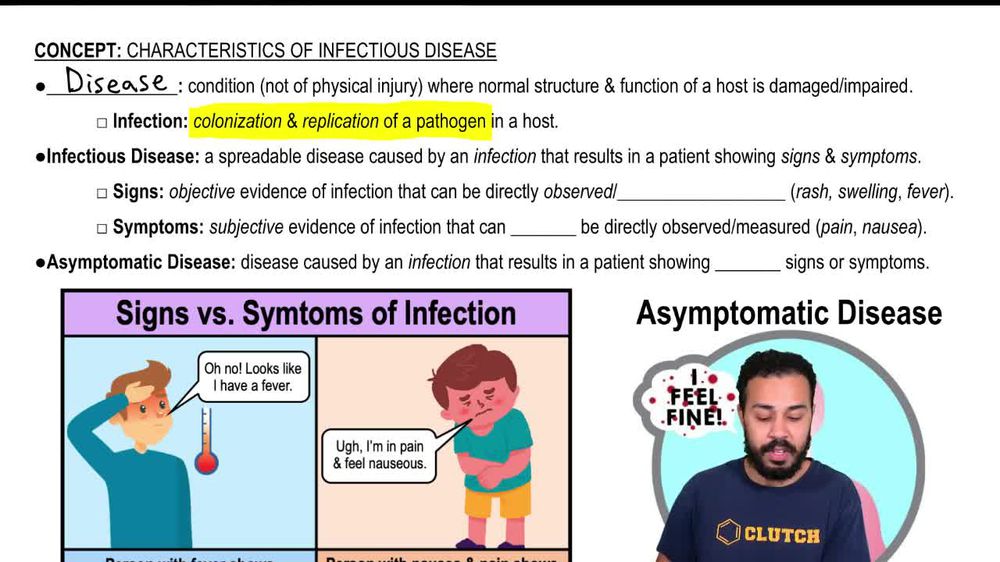
This video solution was recommended by our tutors as helpful for the problem above
Video duration:
1m
Play a video:
0 Comments
Key Concepts
Here are the essential concepts you must grasp in order to answer the question correctly.
Transmission of Infectious Diseases
Many infectious diseases spread through direct contact with contaminated surfaces or secretions. Touching the eyes with unwashed hands can transfer pathogens from the environment to mucous membranes, facilitating infection. Understanding transmission routes helps in identifying preventive measures.
Mucous membranes, such as those in the eyes, nose, and mouth, are common entry points for pathogens. They provide a moist environment that supports microbial invasion, making them vulnerable to infections when contaminated by hands or other objects.
The common cold is caused by viruses that often enter the body through the mucous membranes of the nose and eyes. It spreads easily via respiratory droplets and by touching the face with contaminated hands, making hand hygiene crucial in reducing infection risk.