Ch. 11 - Innate Immunity
Norman-McKay- Microbiology: Basic and Clinical Principles 2nd Edition
Norman-McKay2nd EditionMicrobiology: Basic and Clinical PrinciplesISBN: 9780137661619Not the one you use?Change textbook
Chapter 11, Problem 17

Which of the following is false regarding histamine?
a. Histamine is a vasodilator
b. Histamine increases vascular permeability
c. Histamine is a pro-inflammatory factor
d. Histamine is a pyrogen
e. Histamine is released by leukocytes

Verified step by step guidance
1
Step 1: Understand the role of histamine in the immune response. Histamine is a biogenic amine involved in local immune responses and acts primarily as a mediator of inflammation.
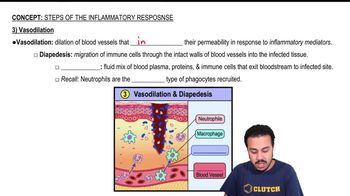
Step 2: Analyze each statement based on histamine's known functions: (a) Histamine causes vasodilation, which means it widens blood vessels to increase blood flow to affected tissues.
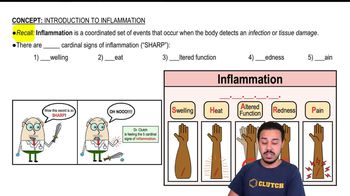
Step 3: Consider statement (b): Histamine increases vascular permeability, allowing immune cells and proteins to pass through blood vessel walls into tissues, which is a key part of inflammation.
Step 4: Evaluate statement (c): Histamine acts as a pro-inflammatory factor by promoting inflammation through vasodilation and increased permeability.
Step 5: Review statements (d) and (e): Histamine is not classified as a pyrogen (a substance that causes fever), and it is primarily released by mast cells and basophils, which are types of leukocytes, so statement (d) is false and statement (e) is true.

Verified video answer for a similar problem:

This video solution was recommended by our tutors as helpful for the problem above.
Video duration:
2m
Was this helpful?

Key Concepts

Here are the essential concepts you must grasp in order to answer the question correctly.

Histamine and Its Role as a Vasodilator

Histamine is a biogenic amine that acts as a vasodilator by relaxing the smooth muscles of blood vessels, leading to increased blood flow. This effect contributes to redness and swelling during inflammatory responses.
Recommended video:
Guided course
02:39
3) Vasodilation

Histamine's Function in Inflammation and Vascular Permeability

Histamine increases vascular permeability by causing endothelial cells to contract, allowing immune cells and fluids to pass into tissues. This action promotes inflammation and helps the immune system respond to injury or infection.
Recommended video:
Guided course
01:38
Introduction to Inflammation

Histamine Release and Its Classification as a Pyrogen

Histamine is primarily released by mast cells and basophils, which are types of leukocytes involved in immune responses. However, histamine is not classified as a pyrogen, which are substances that induce fever; pyrogens include cytokines like interleukin-1.
Recommended video:
Guided course
05:08
Release of Enveloped Viruses