Ch. 3 - Observing Microorganisms Through a Microscope
Tortora - Microbiology: An Introduction 14th Edition
Tortora14th EditionMicrobiology: An IntroductionISBN: 9780138200398Not the one you use?Change textbook
Chapter 3, Problem 2

Which type of microscope would be best to use to observe each of the following?
a. A stained bacterial smear
b. Unstained bacterial cells: the cells are small, and no detail is needed
c. Unstained live tissue when it is desirable to see some intracellular detail
d. A sample that emits light when illuminated with ultraviolet light
e. Intracellular detail of a cell that is 1μm long
f. Unstained live cells in which intracellular structures are shown in color

Verified step by step guidance
1
For each part of the question, identify the key characteristics of the specimen (e.g., stained or unstained, live or fixed, size, and whether fluorescence is involved) and match these to the appropriate microscope type based on their imaging capabilities.
a. For a stained bacterial smear, a bright-field light microscope is typically best because staining increases contrast, allowing clear visualization of bacterial shapes and arrangements.
b. For unstained bacterial cells that are small and where no intracellular detail is needed, a simple light microscope or phase-contrast microscope can be used; phase-contrast enhances contrast without staining, but if no detail is needed, a basic bright-field microscope might suffice.
c. To observe unstained live tissue with some intracellular detail, a phase-contrast or differential interference contrast (DIC) microscope is ideal because these techniques enhance contrast in transparent specimens without staining.
d. For a sample that emits light when illuminated with ultraviolet light, a fluorescence microscope is the best choice since it is designed to detect and image fluorescent emissions from the specimen.
e. To see intracellular detail of a cell that is 1μm long, an electron microscope (such as a transmission electron microscope) is required because its resolution is sufficient to visualize structures at the nanometer scale, far beyond the capability of light microscopes.
f. For unstained live cells where intracellular structures are shown in color, a confocal laser scanning microscope or advanced fluorescence microscopy techniques (using fluorescent dyes or proteins) are appropriate, as they provide color images and detailed intracellular visualization in live cells.

Verified video answer for a similar problem:

This video solution was recommended by our tutors as helpful for the problem above.
Video duration:
3m
Was this helpful?

Key Concepts

Here are the essential concepts you must grasp in order to answer the question correctly.

Types of Microscopes and Their Applications

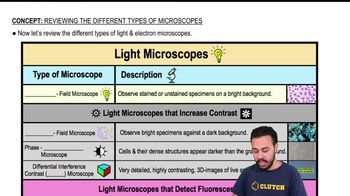
Different microscopes are designed for specific uses based on sample type and desired detail. Light microscopes, including bright-field and phase-contrast, are common for stained or live cells. Fluorescence microscopes detect samples emitting light under UV illumination, while electron microscopes provide high-resolution images of ultrastructure.
Recommended video:
Guided course
05:32
Reviewing the Different Types of Microscopes

Staining and Contrast Techniques in Microscopy

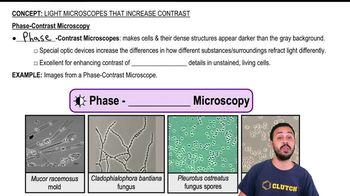
Staining enhances visibility of cells or structures by adding color or contrast, essential for bright-field microscopy. Unstained samples often require specialized techniques like phase-contrast or differential interference contrast (DIC) to visualize cells without dyes, preserving live cell integrity and revealing internal details.
Recommended video:
Guided course
03:52
Phase-Contrast Microscopy

Resolution and Magnification Limits

Resolution is the ability to distinguish two close points as separate, critical for observing fine intracellular details. Light microscopes have a resolution limit around 200 nm, while electron microscopes can resolve structures at the nanometer scale, making them suitable for very small cells or detailed intracellular imaging.
Recommended video:
Guided course
07:29
Magnification, Resolution, & Contrast