Ch. 7 - Microbial Genetics
Bauman - Microbiology with Diseases by Taxonomy 6th Edition
Bauman6th EditionMicrobiology with Diseases by TaxonomyISBN: 9780134832302Not the one you use?Change textbook
Chapter 7, Problem S6

Compare and contrast the structure and components of DNA and RNA in prokaryotes.

Verified step by step guidance
1
Start by identifying the sugar component in the nucleotides of DNA and RNA. DNA contains deoxyribose sugar, which lacks one oxygen atom compared to the ribose sugar found in RNA.
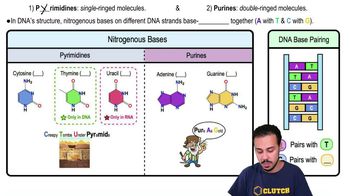
Next, compare the nitrogenous bases present in both molecules. DNA has adenine (A), thymine (T), cytosine (C), and guanine (G), whereas RNA contains adenine (A), uracil (U) instead of thymine, cytosine (C), and guanine (G).
Examine the structural differences: DNA is typically double-stranded forming a double helix, while RNA is usually single-stranded and can fold into various shapes due to intramolecular base pairing.
Consider the functional roles in prokaryotes: DNA stores genetic information, while RNA plays multiple roles including messenger RNA (mRNA) for coding proteins, ribosomal RNA (rRNA) for ribosome structure, and transfer RNA (tRNA) for amino acid transport.
Finally, note the stability differences: DNA is more chemically stable due to its double-stranded structure and deoxyribose sugar, whereas RNA is more prone to hydrolysis because of the 2'-hydroxyl group in ribose, making it less stable in the cellular environment.

Verified video answer for a similar problem:

This video solution was recommended by our tutors as helpful for the problem above.
Video duration:
1m
Was this helpful?

Key Concepts

Here are the essential concepts you must grasp in order to answer the question correctly.

Nucleic Acid Structure

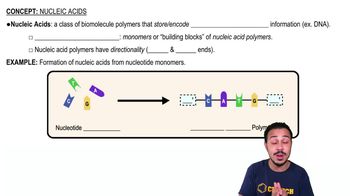
DNA and RNA are nucleic acids composed of nucleotides, each containing a sugar, phosphate group, and nitrogenous base. DNA contains deoxyribose sugar, while RNA contains ribose sugar, which affects their stability and function.
Recommended video:
Guided course
03:22
Nucleic Acids

Nitrogenous Bases

Both DNA and RNA have four nitrogenous bases, but DNA uses thymine (T) whereas RNA uses uracil (U) instead. The other bases—adenine (A), guanine (G), and cytosine (C)—are common to both, influencing base pairing and genetic coding.
Recommended video:
Guided course
07:21
5 Nitrogenous Bases

Molecular Structure and Function in Prokaryotes

In prokaryotes, DNA is typically double-stranded and circular, storing genetic information, while RNA is usually single-stranded and involved in protein synthesis. RNA types include mRNA, tRNA, and rRNA, each playing distinct roles in gene expression.
Recommended video:
Guided course
02:53
Prokaryotic Flagellar Structure