Ch. 11 - Characterizing and Classifying Prokaryotes
Bauman - Microbiology with Diseases by Taxonomy 6th Edition
Bauman6th EditionMicrobiology with Diseases by TaxonomyISBN: 9780134832302Not the one you use?Change textbook
Chapter 11, Problem 3

For each of the following statements that is true, write “true” in the blank. For each statement that is false, write the word(s) that should be substituted for the underlined word(s) to make the statement correct.
__________ If you were to view staphylococci, you should expect to see clusters of cells.

Verified step by step guidance
1
Identify the key term in the statement: 'staphylococci'. This term refers to a genus of bacteria known for their characteristic arrangement.
Recall that 'staphylococci' are Gram-positive cocci that typically group together in clusters resembling grape bunches.
Understand that the statement says: 'If you were to view staphylococci, you should expect to see clusters of cells.' This matches the known morphology of staphylococci.
Since the statement correctly describes the typical arrangement of staphylococci, determine that the statement is true.
Therefore, the correct response is to write 'true' in the blank, confirming the accuracy of the statement.

Verified video answer for a similar problem:

This video solution was recommended by our tutors as helpful for the problem above.
Video duration:
1m
Was this helpful?

Key Concepts

Here are the essential concepts you must grasp in order to answer the question correctly.

Staphylococci Morphology

Staphylococci are spherical bacteria (cocci) that typically group together in irregular clusters resembling grape bunches. This clustering pattern is a key identifying feature distinguishing them from other cocci arrangements like chains or pairs.
Recommended video:
Guided course
02:44
Types of Bacterial Cell Morphology

Bacterial Cell Arrangements

Bacteria can arrange themselves in characteristic patterns such as chains (strepto-), clusters (staphylo-), pairs (diplo-), or singles. Recognizing these arrangements helps in identifying bacterial genera and species under the microscope.
Recommended video:
Guided course
05:26
Cocci Bacterial Cell Arrangements

Microscopic Identification Techniques

Microscopic examination, often after Gram staining, allows visualization of bacterial shape and arrangement. Understanding how to interpret these visual clues is essential for correctly identifying bacteria like staphylococci in clinical and laboratory settings.
Recommended video:
Guided course
03:46
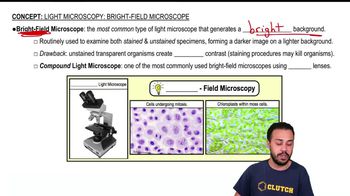
Light Microscopy: Bright-Field Microscopes