Ch. 12 - Characterizing and Classifying Eukaryotes
Bauman - Microbiology with Diseases by Taxonomy 6th Edition
Bauman6th EditionMicrobiology with Diseases by TaxonomyISBN: 9780134832302Not the one you use?Change textbook
Chapter 12, Problem 9

Describe the nuclear divisions that produce eight ascospores in an ascus.

Verified step by step guidance
1
Begin by understanding that an ascus is a sac-like structure in Ascomycete fungi where sexual spores called ascospores are formed.
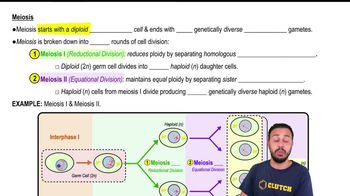
Recognize that the process starts with a diploid nucleus inside the ascus, which undergoes meiosis to reduce the chromosome number by half, producing four haploid nuclei.
Next, each of these four haploid nuclei undergoes a mitotic division, doubling the number of nuclei from four to eight.
These eight nuclei are then enclosed individually by cell walls to form eight ascospores within the ascus.
Summarize the nuclear divisions as one round of meiosis followed by one round of mitosis, resulting in eight haploid ascospores.

Verified video answer for a similar problem:

This video solution was recommended by our tutors as helpful for the problem above.
Video duration:
3m
Was this helpful?

Key Concepts

Here are the essential concepts you must grasp in order to answer the question correctly.

Meiosis in Ascus Formation

Meiosis is a type of nuclear division that reduces the chromosome number by half, producing four haploid nuclei from one diploid nucleus. In ascus formation, meiosis initiates the process by generating these four nuclei, which are the basis for ascospore development.
Recommended video:

Post-meiotic Mitosis

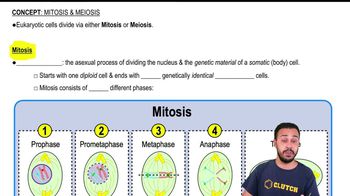
After meiosis, each of the four haploid nuclei undergoes a mitotic division, doubling the number of nuclei to eight. This post-meiotic mitosis is essential for producing the typical eight ascospores found within a mature ascus.
Recommended video:

Ascospore Development and Packaging

The eight nuclei formed after mitosis are enclosed individually by cell walls to become ascospores. These ascospores are then packaged within the ascus, which serves as a protective sac until spore release for fungal reproduction.
Recommended video:
Guided course
04:32
Steps of Biofilm Development