Ch. 3 - Cell Structure and Function
Bauman - Microbiology with Diseases by Taxonomy 6th Edition
Bauman6th EditionMicrobiology with Diseases by TaxonomyISBN: 9780134832302Not the one you use?Change textbook
Chapter 3, Problem 14

Inclusions have been found to contain ___________ .


a. DNA
b. sulfur globules
c. dipicolinic acid
d. tubulin

Verified step by step guidance
1
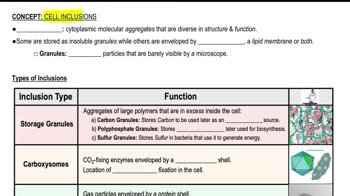
Step 1: Understand what inclusions are in microbiology. Inclusions are reserve deposits found within the cytoplasm of prokaryotic cells, often serving as storage sites for nutrients or other substances.
Step 2: Review the options given: (a) DNA, (b) sulfur globules, (c) dipicolinic acid, and (d) tubulin. Consider which of these substances are typically stored or found as inclusions in bacterial cells.
Step 3: Recall that DNA is generally found in the nucleoid region, not as inclusions. Tubulin is a eukaryotic cytoskeletal protein, not found in prokaryotic inclusions.
Step 4: Recognize that dipicolinic acid is a component of bacterial endospores, not inclusions. Sulfur globules, however, are known to be stored as inclusions in some bacteria, serving as an energy reserve.
Step 5: Conclude that inclusions have been found to contain sulfur globules, making option (b) the correct choice.

Verified video answer for a similar problem:

This video solution was recommended by our tutors as helpful for the problem above.
Video duration:
2m
Was this helpful?

Key Concepts

Here are the essential concepts you must grasp in order to answer the question correctly.

Bacterial Inclusions

Inclusions are reserve deposits found within bacterial cytoplasm that store nutrients or other substances. They serve as energy reserves or structural components, varying in composition depending on the bacterial species and environmental conditions.
Recommended video:
Guided course
05:20
Cell Inclusions

Sulfur Globules as Inclusions

Sulfur globules are a type of inclusion found in some bacteria, especially sulfur-oxidizing species. These globules store elemental sulfur, which bacteria can use as an energy source during metabolism.
Recommended video:
Guided course
05:20
Cell Inclusions

Dipicolinic Acid and Endospores

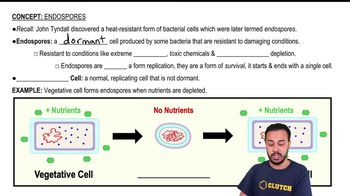
Dipicolinic acid is a chemical found primarily in bacterial endospores, not inclusions. It helps stabilize the spore's DNA and proteins, contributing to spore resistance but is not stored in cytoplasmic inclusions.
Recommended video: