Ch. 11 - The Prokaryotes: Domains Bacteria and Archaea
Tortora - Microbiology: An Introduction 14th Edition
Tortora14th EditionMicrobiology: An IntroductionISBN: 9780138200398Not the one you use?Change textbook
Chapter 11, Problem 5

Which of the following terms is the most specific?
a. bacillus
b. Bacillus
c. gram-positive
d. endospore-forming rods and cocci
e. anaerobic

Verified step by step guidance
1
Understand the context of each term: 'bacillus' refers to a rod-shaped bacterium, 'Bacillus' is a genus of bacteria, 'gram-positive' describes bacteria with a thick peptidoglycan cell wall, 'endospore-forming rods and cocci' refers to bacteria that can form spores, and 'anaerobic' describes bacteria that do not require oxygen.
Identify the hierarchy of specificity: In biological classification, the genus is more specific than shape, cell wall type, or metabolic characteristics.
Recognize that 'Bacillus' is a genus name, which is more specific than the other terms that describe broader characteristics or groups.
Consider that 'bacillus' (lowercase) is a general shape descriptor, not a specific taxonomic category.
Conclude that 'Bacillus' (capitalized) is the most specific term as it refers to a specific genus within the bacterial taxonomy.

Verified video answer for a similar problem:

This video solution was recommended by our tutors as helpful for the problem above.
Video duration:
1m
Was this helpful?

Key Concepts

Here are the essential concepts you must grasp in order to answer the question correctly.

Taxonomic Hierarchy and Specificity

Taxonomic hierarchy organizes living organisms into nested groups from broad to specific, such as domain, kingdom, phylum, class, order, family, genus, and species. The more specific a term, the lower it is in this hierarchy. For example, a genus name like Bacillus is more specific than a general shape or physiological trait.
Recommended video:
Guided course
03:09
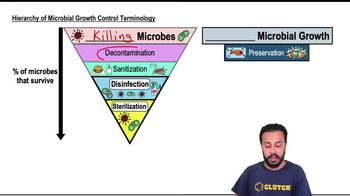
Hierarchy of Microbial Growth Control Terminology

Scientific Nomenclature and Formatting

Scientific names of organisms follow binomial nomenclature, where genus and species names are italicized, with the genus capitalized. The term 'Bacillus' italicized refers to a genus, which is more specific than common descriptive terms like 'bacillus' (a shape). Proper formatting indicates a taxonomic rank rather than a general characteristic.
Recommended video:
Guided course
06:29
Scientific Method

Microbial Morphology and Physiology Terms

Terms like 'bacillus' (rod-shaped), 'gram-positive', 'endospore-forming', and 'anaerobic' describe morphology or physiological traits. These are broader categories that can apply to many different genera or species, making them less specific than a taxonomic genus name.
Recommended video:
Guided course
01:13
Bacterial Cell Morphology & Arrangements