Ch. 2 - Biochemistry Basics
Norman-McKay- Microbiology: Basic and Clinical Principles 2nd Edition
Norman-McKay2nd EditionMicrobiology: Basic and Clinical PrinciplesISBN: 9780137661619Not the one you use?Change textbook
Chapter 2, Problem 15

Cholesterol is best described as
a. A lipid.
b. A sterol.
c. An alcohol.
d. A fat.
e. A wax.

Verified step by step guidance
1
Step 1: Understand the classification of cholesterol by examining its chemical structure and properties. Cholesterol is a molecule found in cell membranes and is important for maintaining membrane fluidity and serving as a precursor for steroid hormones.
Step 2: Recognize that cholesterol belongs to a specific subgroup of lipids known as sterols. Sterols are characterized by a four-ring core structure called the steroid nucleus.
Step 3: Note that cholesterol contains a hydroxyl (-OH) group, which classifies it chemically as an alcohol, but this is a functional group within the larger sterol structure.
Step 4: Differentiate cholesterol from fats and waxes. Fats are typically triglycerides composed of glycerol and fatty acids, while waxes are esters of long-chain fatty acids and alcohols, which cholesterol is not.
Step 5: Conclude that the best description of cholesterol is that it is a sterol, which is a type of lipid with an alcohol functional group, making options (a), (b), and (c) partially correct but (b) the most precise classification.

Verified video answer for a similar problem:

This video solution was recommended by our tutors as helpful for the problem above.
Video duration:
1m
Was this helpful?

Key Concepts

Here are the essential concepts you must grasp in order to answer the question correctly.

Lipids

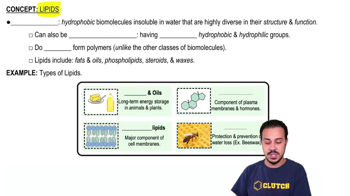
Lipids are a broad group of hydrophobic or amphipathic molecules including fats, oils, waxes, and steroids. They serve as energy storage, structural components of cell membranes, and signaling molecules. Cholesterol falls under this category due to its hydrophobic nature.
Recommended video:

Sterols

Sterols are a subgroup of steroids characterized by a hydroxyl group at the 3-position of the A-ring. They are important components of cell membranes, influencing fluidity and permeability. Cholesterol is the most common sterol in animal cells.

Alcohol Functional Group

An alcohol is an organic compound containing one or more hydroxyl (-OH) groups attached to a carbon atom. Cholesterol contains a single hydroxyl group, classifying it chemically as an alcohol, but this is only part of its structure and function.
Recommended video:
Guided course
06:04
Functional Groups