How many copies could PCR make if we started with one copy of a template and performed 15 cycles of copying? a. A few b. A few hundred c. A few thousand d. Millions
Verified step by step guidance
1
Understand that PCR (Polymerase Chain Reaction) amplifies DNA by doubling the number of copies each cycle, assuming 100% efficiency.
Recall the formula for the number of DNA copies after n cycles starting from one copy: \(\text{Number of copies} = 2^{n}\), where \(n\) is the number of cycles.
Substitute the given number of cycles (15) into the formula: \(\text{Number of copies} = 2^{15}\).
Calculate or estimate the value of \$2^{15}$ to determine the approximate number of copies produced after 15 cycles.
Compare the calculated number to the options provided (a few, a few hundred, a few thousand, millions) to select the correct answer.
Verified video answer for a similar problem:
This video solution was recommended by our tutors as helpful for the problem above
Video duration:
2m
Play a video:
0 Comments
Key Concepts
Here are the essential concepts you must grasp in order to answer the question correctly.
Polymerase Chain Reaction (PCR) Basics
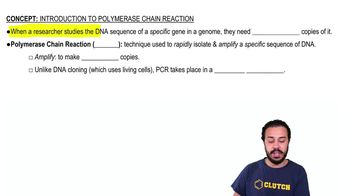
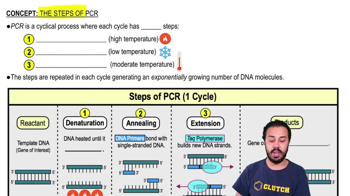
PCR is a technique used to amplify a specific DNA segment exponentially by cycling through denaturation, annealing, and extension steps. Each cycle ideally doubles the number of DNA copies, leading to rapid accumulation of the target sequence.
In PCR, the number of DNA copies doubles with each cycle, so after n cycles, the total copies equal 2^n. Starting with one copy, 15 cycles would produce 2^15 copies, illustrating the power of exponential growth in molecular biology.
To estimate the number of DNA copies after PCR, use the formula 2^n, where n is the number of cycles. For 15 cycles, 2^15 equals 32,768 copies, which corresponds to tens of thousands, helping to choose the correct answer from the options.