Acellular Infectious Agents: Viruses, Viroids & Prions quiz #3 Flashcards

Acellular Infectious Agents: Viruses, Viroids & Prions quiz #3
Control buttons has been changed to "navigation" mode.
1/40
  • Some viruses, such as human herpesvirus 1, infect a cell without causing symptoms. These are called
    These are called latent viruses.
  • Which group of organisms are viroids (not viruses) most likely to parasitize?
    Viroids most commonly parasitize plants.
  • A(n) ______ is an infectious protein and is simpler than a virus.
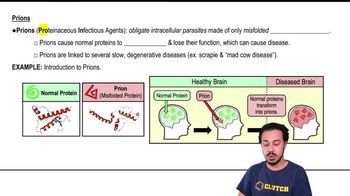
    A prion is an infectious protein and is simpler than a virus.
  • Select the two characteristics that all viruses share.
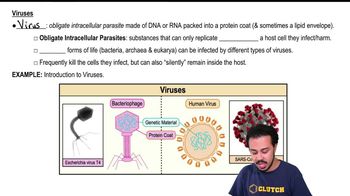
    All viruses have genetic material and a protein coat.
  • What is the main function of the viral capsid and envelope?
    The capsid and envelope protect the viral genome and aid in host cell attachment.
  • Place the statements about viroids and prions into the correct columns. Not all statements are used.
    Viroids: Infect plants, made of circular RNA. Prions: Infectious proteins, cause degenerative diseases.
  • Which of the following statements best supports the argument that viruses are nonliving?
    Viruses are nonliving because they are not made of cells and cannot reproduce independently.
  • What are the components common to all virions?
    All virions have genetic material and a protein capsid.
  • Measles viruses are capable of inactivating host defenses by
    Measles viruses can suppress the host immune response.
  • Emerging viruses that infect human cells can originate from __________.
    Emerging viruses can originate from animal reservoirs.
  • Select the true statement about viral infection of a host cell.
    Viruses must enter a host cell to replicate.
  • Bacteriophages and animal viruses do not differ significantly in which one of the following steps?
    Both bacteriophages and animal viruses attach to host cells.
  • Helical and icosahedral are terms used to describe the shapes of a virus
    Helical and icosahedral describe the shapes of viral capsids.
  • What are the three parts that make up the structure of most viruses?
    Most viruses have genetic material, a protein capsid, and sometimes an envelope.
  • Budding is the release of ______ viruses.
    Budding is the release of enveloped viruses.
  • Which characteristic of viruses prevents them from being used as evidence to support cell theory?
    Viruses are acellular, so they do not support cell theory.
  • Which of the following are characteristics of a virus?
    Viruses are acellular, have genetic material, and require a host to replicate.
  • Mad cow disease is caused by a noncellular infectious agent called a
    Mad cow disease is caused by a prion.
  • A common characteristic of viral pneumonia is
    Viral pneumonia often presents with nonproductive cough and diffuse lung involvement.
  • Viroids are tiny molecules of circular _____ that are important infectious agents of _____.
    Viroids are tiny molecules of circular RNA that infect plants.
  • The limitation of the type of cell that a virus can invade is called the
    The limitation is called the host range.
  • Virus nucleic acid is injected into host cell
    The viral genome is injected into the host cell during infection.
  • Which of the following processes can viruses carry out
    Viruses can replicate only inside a host cell.
  • Viruses can be grown in all of the following except __________.
    Viruses cannot be grown in nonliving media.
  • Viruses are nonliving particles with a(n) made of nucleic acids.
    Viruses are nonliving particles with a genome made of nucleic acids.
  • All viruses are made up of two components. These components are
    All viruses have genetic material and a protein capsid.
  • Bacteriophages derive all of the following from the host cell except
    Bacteriophages do not derive their protein capsid from the host cell.
  • A retrovirus has a genome that consists of __________.
    A retrovirus has a genome consisting of RNA.
  • What structure is found in viruses but not in cells?
    The protein capsid is found in viruses but not in cells.
  • An example of a latent virus infection is __________.
    Herpes simplex virus infection is an example of a latent virus infection.
  • Which of the following cannot be used to culture viruses
    Viruses cannot be cultured in nonliving media.
  • The nucleocapsid is composed of ______.
    The nucleocapsid is composed of the viral genome and the protein capsid.
  • A prion is best described as ______.
    A prion is a misfolded infectious protein.
  • Endotoxins are also known as
    Endotoxins are also known as lipopolysaccharides from bacterial cell walls.
  • Select the description that would represent a pathogen that would be considered a virus.
    A virus is an acellular particle with genetic material in a protein coat that infects living cells.
  • Host cells of viruses include
    Viruses can infect all forms of life: bacteria, archaea, and eukaryotes.
  • The nucleocapsid is composed of
    The nucleocapsid is composed of the viral genome and the protein capsid.
  • A(n) ________ is the portion of virus code that is unique to a particular computer virus.
    This refers to computer viruses; in biology, viruses have unique genetic sequences.
  • All of the following are characteristics of viruses except
    Viruses do not carry out metabolism.
  • Because the virus that causes influenza mutates, a new vaccine is created every year.
    True. Influenza virus mutates frequently, requiring new vaccines annually.