What is the process of transformation in bacteria?
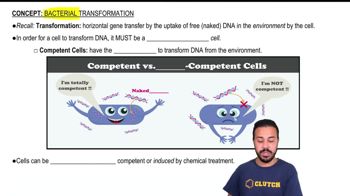
Transformation in bacteria is the uptake of free or naked DNA from the environment by a competent cell, allowing the cell to acquire new genetic traits.
New alleles that might allow a bacterium to become resistant to an antibiotic arise through what process?
New alleles can arise through the uptake and integration of external DNA via transformation, which may include genes conferring antibiotic resistance.
What is a common method used to introduce recombinant DNA (rDNA) into bacterial host cells?
A common method is transformation, where competent bacterial cells take up recombinant DNA from their environment.
The process by which external DNA is transferred to a different bacterial cell is referred to as what?
This process is referred to as transformation.
When a bacterium acquires a new trait from its temperate phage, it is called what?
When a bacterium acquires a new trait from its temperate phage, it is called lysogenic conversion.
Cells that have the ability to take up DNA from the environment are called what kind of cells?
Cells that can take up DNA from the environment are called competent cells.
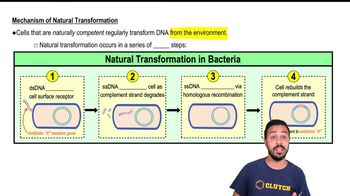
What happens to one strand of the double-stranded DNA during the process of natural transformation?
One strand of the double-stranded DNA is degraded, while the other strand enters the competent cell.
How does the single-stranded DNA integrate into the host cell's chromosome during transformation?
The single-stranded DNA integrates into the host chromosome via homologous recombination.
What is a common source of free DNA in the environment for natural transformation?
Free DNA often comes from nearby cells that have lysed or ruptured, releasing their DNA into the environment.
What is the final step in the mechanism of natural transformation after DNA integration?
The cell rebuilds the complementary DNA strand, restoring the double-stranded region in the chromosome.
 Back
Back
 03:06
03:06