Control buttons has been changed to "navigation" mode.
1/10
Terms in this set (10)
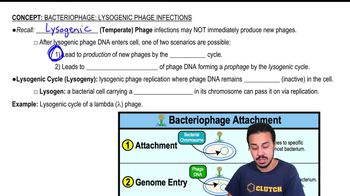
Which of the following statements accurately describes the lysogenic cycle of lambda (λ) phage?
During the lysogenic cycle of lambda (λ) phage, the phage DNA integrates into the host bacterium's chromosome as a prophage, remains inactive, and is replicated along with the host cell's DNA, passing to future generations without producing new phages until certain conditions trigger excision and entry into the lytic cycle.
During the bacteriophage lysogenic cycle, what happens to the phage DNA within the host cell?
During the bacteriophage lysogenic cycle, the phage DNA integrates into the host cell's chromosome as a prophage, remains inactive, and is replicated along with the host cell's DNA, allowing it to be passed on to daughter cells.
What is a lysogen in the context of lysogenic phage infections?
A lysogen is a bacterial cell that contains an integrated phage DNA, known as a prophage, within its chromosome.
What triggers the transition from the lysogenic cycle to the lytic cycle in bacteriophages?
Certain environmental conditions can trigger the excision of the prophage from the host chromosome, initiating the lytic cycle.
How does lysogenic conversion affect the host cell's surface structures?
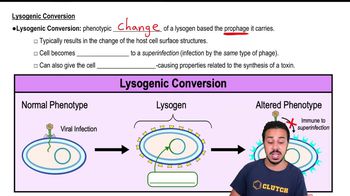
Lysogenic conversion can alter the host cell's surface structures, making it resistant to infection by the same type of phage.
What is superinfection immunity in lysogenic bacteria?
Superinfection immunity is when a lysogen becomes resistant to infection by the same type of phage due to changes in its surface structures.
How can lysogenic conversion contribute to bacterial pathogenicity?
Lysogenic conversion can endow the host cell with disease-causing properties, such as the ability to synthesize toxins.
What role does the prophage play during bacterial cell division in the lysogenic cycle?
During cell division, the prophage is replicated along with the host chromosome and passed on to all daughter cells.
What is the function of viral enzymes during the lysogenic cycle?
Viral enzymes can excise the prophage from the host chromosome, allowing the phage to enter the lytic cycle.
Why are all offspring of a lysogen also considered lysogens?
All offspring inherit the integrated prophage during cell division, so they are also lysogens.