In which phase of a Bacillus cell culture would you expect to observe the most endospores?
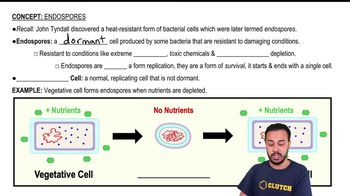
You would expect to observe the most endospores during the stationary or death phase, when nutrients are depleted and cells undergo sporulation to survive unfavorable conditions.
What are three advantages of endospore formation for bacteria?
Three advantages of endospore formation are: survival in extreme heat, resistance to toxic chemicals, and the ability to endure nutrient depletion.
Why is steam used in the endospore staining procedure?
Steam is used in the endospore staining procedure to help the stain penetrate the multiple protective layers of the endospore, allowing for proper visualization under a microscope.
What is the primary function of bacterial endospores?
Bacterial endospores primarily function in survival during unfavorable environmental conditions, such as heat, chemical exposure, and nutrient depletion.
Which of the following characteristics apply to endospores?
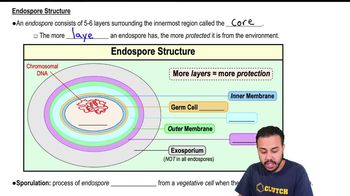
Endospores are dormant, highly resistant to environmental stresses, produced by some gram-positive bacteria, and have multiple protective layers surrounding their core.
Who discovered the heat-resistant forms of bacterial cells later termed endospores?
John Tyndall discovered the heat-resistant forms of bacterial cells that were later called endospores.
What is the scientific term for a normal, actively replicating bacterial cell?
A normal, actively replicating bacterial cell is called a vegetative cell.
What is the process called by which a vegetative cell forms an endospore under unfavorable conditions?
The process is called sporulation, which occurs when the environment becomes unfavorable for the vegetative cell.
Where is the chromosomal DNA stored within an endospore?
The chromosomal DNA is stored in the core of the endospore.
What is the outermost layer of an endospore called, and is it always present?
The outermost layer is called the exosporium, and it is not always present in all endospores.