Skip to main content
Microbiology
My Course
Learn
Exam Prep
AI Tutor
Study Guides
Textbook Solutions
Flashcards
Explore
Try the app
My Course
Learn
Exam Prep
AI Tutor
Study Guides
Textbook Solutions
Flashcards
Explore
Try the app
Back
Introduction to Microscopes quiz #3
You can tap to flip the card.
The lens that is within the eyepiece of the light microscope is called the:
You can tap to flip the card.
👆
The lens that is within the eyepiece of the light microscope is called the:
It is called the ocular lens.
Track progress
Control buttons has been changed to "navigation" mode.
1/9
Related flashcards
Related practice
Recommended videos
Introduction to Microscopes quiz #1
Introduction to Microscopes
40 Terms
Introduction to Microscopes quiz #2
Introduction to Microscopes
40 Terms
Introduction to Microscopes definitions
Introduction to Microscopes
15 Terms
Introduction to Microscopes
9. Microscopes
5 problems
Topic
Monica
Magnification, Resolution, & Contrast
9. Microscopes
7 problems
Topic
Nicole
9. Microscopes - Part 1 of 2
6 topics
12 problems
Chapter
Nicole
9. Microscopes - Part 2 of 2
8 topics
10 problems
Chapter
Nicole
Guided course
06:13
Introduction to Microscopes
3377
views
65
rank
1
comments
Terms in this set (9)
Hide definitions
The lens that is within the eyepiece of the light microscope is called the:
It is called the ocular lens.
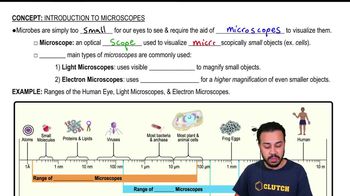
What is the main difference between light microscopes and electron microscopes?
Light microscopes use visible light for magnification, while electron microscopes use electrons for much higher magnification.
Why are microscopes necessary for studying microbes?
Microbes are too small to be seen with the naked eye, so microscopes are needed to visualize them.
Which type of microscope is generally required to see viruses?
Electron microscopes are generally required to see viruses because they are much smaller than bacteria and animal cells.
How do the sizes of eukaryotic cells compare to prokaryotic cells?
Eukaryotic cells are generally larger and contain a nucleus, while prokaryotic cells are smaller and lack a nucleus.
What types of objects can be visualized with a light microscope?
Light microscopes can visualize most bacteria, archaea, and animal cells, but not viruses.
What is the main limitation of the human eye in observing microscopic objects?
The human eye cannot see most plant and animal cells, bacteria, archaea, or viruses due to their small size.
What kinds of molecules can electron microscopes visualize that light microscopes cannot?
Electron microscopes can visualize smaller molecules like proteins, lipids, and even some atoms.
Why are electron microscopes more expensive and complex than light microscopes?
Electron microscopes are more powerful and require advanced technology to use electrons for magnification, making them more expensive and complex.
 BackBack
 06:13
06:13