Microbiology
My Course
Learn
Exam Prep
AI Tutor
Study Guides
Textbook Solutions
Flashcards
Explore
My Course
Learn
Exam Prep
AI Tutor
Study Guides
Textbook Solutions
Flashcards
Explore
Back
Members of the Bacterial World quiz #5
You can tap to flip the card.
Bacilli, which are rod-shaped, spore-forming bacteria, cause:
You can tap to
flip the card.
👆
Bacilli, which are rod-shaped, spore-forming bacteria, cause:
Diseases such as anthrax and botulism.
Track progress
Control buttons has been changed to "navigation" mode.
1/10
Related flashcards
Related practice
Recommended videos
Guided course
06:17
Members of the Bacterial World
Jason
6248
views
176
rank
Terms in this set (10)
Hide definitions
Bacilli, which are rod-shaped, spore-forming bacteria, cause:
Diseases such as anthrax and botulism.
Match each characteristic to the proper bacterial fertility factor type.
F+ cells have the fertility plasmid; F- cells do not; Hfr cells have the plasmid integrated into the chromosome.
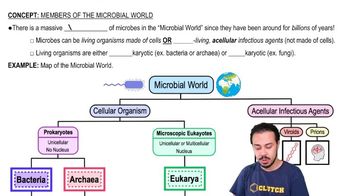
What are the two main branches of the microbial world?
The microbial world branches into cellular organisms (living and made of cells) and acellular infectious agents (not made of cells).
Which types of organisms do microbiologists primarily focus on within the eukaryotes?
Microbiologists primarily focus on microscopic eukaryotes such as fungi, protists (algae and protozoa), and helminths.
How do prokaryotic and eukaryotic cells differ in terms of their cellular structure?
Prokaryotic cells are unicellular and lack a nucleus, while eukaryotic cells can be unicellular or multicellular and have a nucleus.
Name the three categories of acellular infectious agents.
The three categories of acellular infectious agents are viruses, viroids, and prions.
Which two groups make up the prokaryotes?
Prokaryotes are made up of bacteria and archaea.
Why are bacteria and archaea considered to be very different from each other?
Bacteria and archaea are as different from each other as they are from eukaryotes, which is why they are classified into separate domains.
What does the term 'acellular' mean when describing infectious agents?
Acellular means that the infectious agents are not made of cells.
Which eukaryotic groups are not shown in the microbial world map but exist?
Not all eukaryotic groups are shown in the map; only those most focused on by microbiologists, such as fungi, protists, and helminths, are included.