Reviewing the Environmental Factors of Microbial Growth quiz #1 Flashcards

Reviewing the Environmental Factors of Microbial Growth quiz #1
Control buttons has been changed to "navigation" mode.
1/10
  • What is the most important environmental factor influencing bacterial growth?
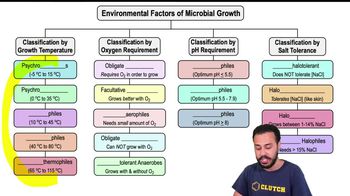
    Temperature is often considered the most important environmental factor influencing bacterial growth, as it determines the rate of metabolic reactions and classifies microbes into groups such as psychrophiles, mesophiles, thermophiles, and hyperthermophiles.
  • What temperature range do psychrophiles prefer for growth?
    Psychrophiles grow best in extremely cold environments, specifically between -5°C and 15°C.
  • Which group of microbes can grow in refrigerators and what is their temperature range?
    Psychrotrophs can grow in cool environments like refrigerators, with a temperature range of 0°C to 35°C.
  • What is the optimal pH range for neutrophiles?
    Neutrophiles prefer an optimal pH range near neutral, between 5.5 and 7.9.
  • How do facultative anaerobes respond to the presence or absence of oxygen?
    Facultative anaerobes can grow with or without oxygen, but they grow better when oxygen is present due to increased ATP production.
  • What is the oxygen requirement for obligate anaerobes?
    Obligate anaerobes cannot grow in the presence of oxygen and require environments that lack oxygen.
  • Which microbes require only a small amount of oxygen for growth?
    Microaerophiles need a small amount of oxygen; too much or too little oxygen is harmful to them.
  • What is the salt tolerance of non-halotolerant organisms?
    Non-halotolerant organisms cannot tolerate salt and must grow in environments with very low sodium chloride concentrations.
  • What pH do alkalophiles prefer for optimal growth?
    Alkalophiles thrive in basic or alkali environments with a pH of 8 or higher.
  • What distinguishes extreme halophiles from other halophiles?
    Extreme halophiles grow in environments with very high salt concentrations, specifically greater than 15% sodium chloride.