Skip to main content
Microbiology
My Course
Learn
Exam Prep
AI Tutor
Study Guides
Textbook Solutions
Flashcards
Explore
Try the app
My Course
Learn
Exam Prep
AI Tutor
Study Guides
Textbook Solutions
Flashcards
Explore
Try the app
Back
Ch. 16 - Concepts of Immunity
You can tap to flip the card.
What are the two main types of immunity?
You can tap to flip the card.
👆
What are the two main types of immunity?
Innate immunity
(non-specific, first line defense) and
adaptive immunity
(specific, memory response involving lymphocytes).
Track progress
Control buttons has been changed to "navigation" mode.
1/20
Recommended videos
Guided course
05:52
Innate vs. Adaptive Immunity
3665
views
84
rank
Guided course
02:58
Antigens & Antibodies
2330
views
89
rank
Terms in this set (20)
Hide definitions
What are the two main types of immunity?
Innate immunity
(non-specific, first line defense) and
adaptive immunity
(specific, memory response involving lymphocytes).
What is the primary function of innate immunity?
Provides a
non-specific defense
present at birth, with no memory response, responding quickly to pathogens.
What cells are involved in adaptive immunity?
Lymphocytes
, specifically
T cells
and
B cells
, which provide a specific and memory-based immune response.
What are Pathogen-Associated Molecular Patterns (PAMPs)?
Broad molecular patterns on microbes recognized by innate immune cells to trigger defense responses.
Name three physical barriers involved in innate immunity.
Skin, mucous membranes, and the lacrimal apparatus (tear production).
What role does lysozyme play in immunity?
An enzyme in tears and perspiration that breaks down bacterial cell walls, especially gram-positive bacteria.
How do normal microbiota contribute to innate immunity?
They limit pathogen attachment sites, produce inhibitory substances, and help develop the immune system.
What are the main types of leukocytes (white blood cells)?
Granulocytes (neutrophils, eosinophils, basophils) and agranulocytes (lymphocytes, monocytes).
What is the function of macrophages in immunity?
Phagocytose pathogens and activate adaptive immunity by presenting antigens.
List the six steps of phagocytosis.
1. Chemotaxis, 2. Recognition & attachment, 3. Ingestion, 4. Phagolysosome formation, 5. Digestion, 6. Elimination.
What is chemotaxis in phagocytosis?
The movement of phagocytes toward the site of infection in response to chemical signals.
What happens during phagolysosome formation?
The phagosome fuses with a lysosome to form a phagolysosome where digestion occurs.
What is inflammation and its main purpose?
A local defensive response to tissue damage that destroys injurious agents, limits damage spread, and repairs tissue.
Name four signs of inflammation.
Pain, redness, immobility, swelling, and heat.
How does fever contribute to immunity?
Cytokines raise body temperature to inhibit microbial growth and enhance immune response.
What are antimicrobial substances in the second line of defense?
Complement proteins, interferons, and iron-binding proteins that help destroy microbes.
What is the complement system?
A group of over 30 liver-produced proteins that enhance immune responses by opsonization, inflammation, and cytolysis.
Name the three complement activation pathways.
Classical (antibody-dependent), alternative (antibody-independent), and lectin (pattern recognition).
What is opsonization?
The process where complement proteins coat pathogens to enhance phagocytosis.
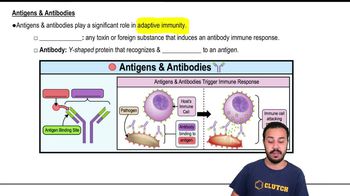
What are the main functions of antibodies?
Bind to specific antigens to neutralize pathogens and activate the complement system.
 BackBack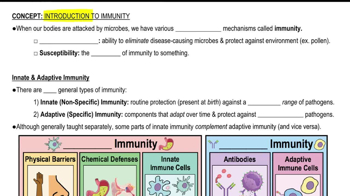
 05:52
05:52