 Back
Backchpt 20
 05:33
05:33
Terms in this set (20)
Chemotherapy is the use of drugs to treat a disease by interfering with the growth of microbes within a host.
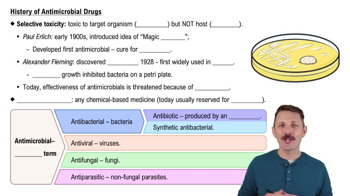
An antibiotic is a substance produced by a microbe that, in small amounts, inhibits the growth of another microbe.
Selective toxicity means killing harmful microbes without damaging the host.
Broad-spectrum antibiotics target both Gram-positive and Gram-negative bacteria, while narrow-spectrum target specific types of microbes.
A superinfection is the overgrowth of normal microbiota that is resistant to antibiotics, often causing resistant bacterial or fungal infections.
1. Inhibition of cell wall synthesis
2. Inhibition of protein synthesis
3. Inhibition of nucleic acid replication and transcription
4. Injury to plasma membrane
5. Inhibition of essential metabolic synthesis
Because bacterial cell walls contain peptidoglycan, which is absent in human cells, making these drugs selectively toxic to bacteria.
Penicillins, cephalosporins, bacitracin, and vancomycin inhibit bacterial cell wall synthesis.
They bind to bacterial ribosomal subunits (30S or 50S), blocking translation steps such as peptide formation or translocation.
Viruses use host cell machinery and lack their own metabolism, making it hard to target viruses without harming host cells.
Disk diffusion (Kirby-Bauer) test and E-test (epsilometer) are used to assess antibiotic sensitivity and minimal inhibitory concentration (MIC).
MIC is the minimal inhibitory concentration that stops growth; MBC is the minimal bactericidal concentration that kills bacteria.
Drug resistance is an adaptive response where microbes tolerate drug amounts that would normally inhibit them.
Through spontaneous mutations or horizontal gene transfer via plasmids (R factors) and transposons.
Using outdated drugs, treating viral infections, incomplete regimens, and using antibiotics in animal feed.
Synergism: combined effect greater than individual effects.
Antagonism: combined effect less than individual effects.
Broad-spectrum agents like nisin (from lactic acid bacteria), defensins (human), magainin (frogs), and squalamine (sharks) used in new therapies.
Phage therapy uses bacteriophages to target and kill specific bacterial pathogens as an alternative to antibiotics.
They inhibit bacterial cell wall synthesis by binding to enzymes that cross-link peptidoglycan.
Penicillinase is an enzyme that breaks down penicillin, causing resistance to natural penicillins.