 Back
BackFundamentals of Microbiology
 03:55
03:55

Terms in this set (27)
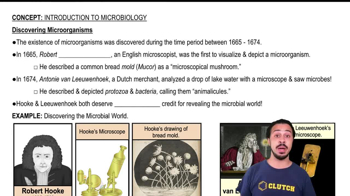
Antoni van Leeuwenhoek was a Dutch tailor and lens grinder who first discovered the bacterial world using high-quality simple microscopes with 50-300x magnification. He called microorganisms "animalcules".
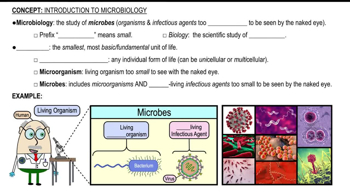
The taxonomic system is a method of naming and grouping similar organisms, developed by Swedish botanist Carolus Linnaeus. Microorganisms are grouped into bacteria, archaea, fungi, protozoa, algae, and small multicellular animals.
Bacteria and archaea are prokaryotic but bacteria have peptidoglycan in their cell walls while archaea do not. Archaea live in extreme environments and are not known to cause disease, unlike bacteria.
Fungi are eukaryotic organisms with cell walls that obtain food from other organisms. They include molds (multicellular with filaments) and yeasts (unicellular, oval or round).
Protozoa are single-celled eukaryotes that move using cilia (short, numerous), flagella (long, few), or pseudopods (cell extensions flowing in the direction of travel).
Algae are unicellular or multicellular photosynthetic eukaryotes found in freshwater and oceans. They produce agar used in lab media and contribute to oxygen production.
Viruses are acellular obligatory parasites that require a host to replicate, unlike cellular microorganisms like bacteria and fungi.
Redi disproved spontaneous generation for larger animals by showing that maggots come from flies, not spontaneous life.
Needham concluded that a "life force" caused spontaneous generation because heated broth still showed microbial growth, though his methods were flawed.
Spallanzani showed that heating broth longer and sealing vials prevented microbial growth, disproving spontaneous generation and showing contamination from air microbes.
Pasteur demonstrated that microbes come from dust particles in air, not spontaneous generation, using swan-neck flask experiments.
Pasteurization is a heat treatment that destroys pathogens in foods and beverages like milk and juice to prevent diseases such as tuberculosis and brucellosis.
The germ theory states that specific microorganisms (pathogens) cause specific diseases.
Koch identified Bacillus anthracis as the cause of anthrax, developed staining techniques, used Petri dishes, and formulated Koch's postulates to prove disease causation.
A series of steps to prove that a specific microorganism causes a specific infectious disease.
Gram staining is a method to differentiate bacteria into Gram-positive and Gram-negative based on cell wall properties, developed by Hans Christian Gram.
Semmelweis introduced handwashing with chlorinated lime water in obstetric wards to prevent puerperal fever.
Lister pioneered antiseptic techniques by using carbolic acid to reduce wound infections during surgery.
Nightingale introduced cleanliness and antiseptic practices in nursing, significantly reducing infections during the Crimean War.
Epidemiology studies disease occurrence and spread; John Snow is a founder for linking cholera to contaminated water.
Jenner developed the first vaccine using cowpox to protect against smallpox, initiating immunology.
Magic bullets are chemicals that selectively kill pathogens without harming humans, introduced by Paul Ehrlich, founding chemotherapy.
Microbes recycle nutrients, produce vitamins, and are used in bioremediation to detoxify polluted environments.
Biochemistry studies metabolism and chemical reactions in living organisms, often using microbes as model systems.
Microbial genetics studies genes in DNA, enabling advances in molecular biology, recombinant DNA technology, and gene therapy.
Emerging diseases are new or rare infections in humans; re-emerging diseases were once controlled but are becoming significant again.
Factors include abandonment of control programs, HIV coinfection, and increased drug resistance.