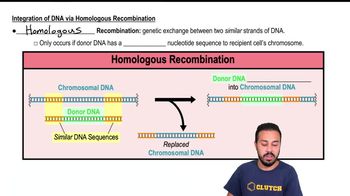
Genetic recombination is the exchange of genes between two DNA molecules to form new gene combinations on a chromosome, often involving crossing over.
What enzyme catalyzes the joining of DNA strands during recombination?
The RecA protein catalyzes the joining of donor and recipient DNA strands during genetic recombination.
Difference between horizontal and vertical gene transfer
Vertical gene transfer passes genes from parent to offspring, while horizontal gene transfer transfers genes between cells of the same generation.
What are plasmids?
Plasmids are self-replicating, circular DNA molecules found mainly in bacteria that carry genes, often for survival advantages like antibiotic resistance.
What is the F factor in bacteria?
The F factor is a conjugative plasmid carrying genes for sex pili and plasmid transfer during bacterial conjugation.
Why are R factors clinically important?
R factors are plasmids that carry genes encoding resistance to antibiotics and toxins, contributing to antibiotic-resistant bacterial populations.
What role do plasmids play in bacterial pathogenicity?
Plasmids can carry genes for toxin production and attachment factors, turning harmless bacteria into pathogens.
What are transposons?
Transposons are DNA segments that can move within or between DNA molecules, sometimes carrying genes like antibiotic resistance.
What enzyme do transposons encode for movement?
Transposons encode transposase, an enzyme that cuts and reseals DNA during transposition.
Why are transposons called 'jumping genes'?
Because they can move from one DNA location to another, inserting themselves into different sites within chromosomes or plasmids.
What is bacterial transformation?
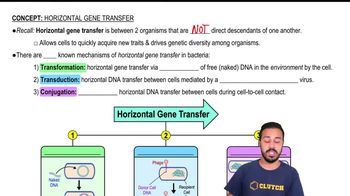
Transformation is the uptake of naked DNA from the environment by a bacterial cell, which can then integrate it into its chromosome.
What was Griffith's experiment demonstrating transformation?
Griffith showed that dead encapsulated bacteria could transfer genetic material to live nonencapsulated bacteria, making them virulent.
Which molecule was identified as the transforming factor in bacteria?
DNA was identified as the transforming factor responsible for genetic change in bacteria.
What does it mean for a bacterial cell to be competent?
A competent cell can take up donor DNA from its environment during transformation.
What is bacterial conjugation?
Conjugation is the transfer of genetic material between bacteria via direct cell-to-cell contact, often mediated by plasmids.
What is an F+ cell?
An F+ cell contains the F factor plasmid and can donate it to an F- cell during conjugation.
What is an Hfr cell?
An Hfr cell has the F factor integrated into its chromosome and can transfer chromosomal genes to an F- cell during conjugation.
Do bacteria reproduce during conjugation?
No, conjugation transfers DNA between cells but does not involve bacterial reproduction.
What is transduction in bacteria?
Transduction is the transfer of bacterial DNA from a donor to a recipient cell inside a bacteriophage (virus) particle.
What is generalized transduction?
Generalized transduction occurs when any bacterial DNA fragment is accidentally packaged into a phage and transferred to another bacterium.
How can bacteria acquire toxin genes via transduction?
Bacteriophages can carry toxin genes from one bacterial host to another during specialized transduction.
 Back
Back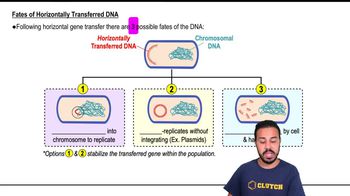
 03:13
03:13