 Back
BackIntroduction to Microbiology
 03:55
03:55

Terms in this set (20)
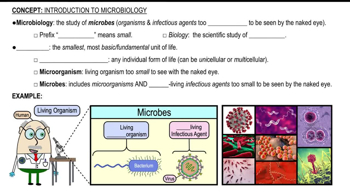
Microbiology is the study of organisms too small to see with the unaided eye.
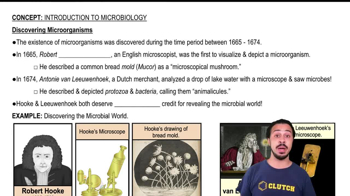
Antoni van Leeuwenhoek first observed microorganisms in the 1600s using high-quality magnifying lenses to create a simple microscope.
The three domains are Domain Bacteria, Domain Archaea, and Domain Eukarya.
He first saw relatively large cells with organelles, now known as eukaryotes in Domain Eukarya.
Examples include photosynthetic algae with chloroplasts, phagocytic protozoa, and fungi that absorb organic matter and have cell walls.
Prokaryotes are very small cells with no organelles, divided into Domain Archaea and Domain Bacteria based on rRNA differences.
Gram-positive bacteria have a thick peptidoglycan cell wall and are sensitive to antibiotics like penicillin.
Gram-negative bacteria have an outer phospholipid bilayer with an LPS layer containing toxic lipid A, often resistant to penicillin.
Viruses consist of one or several pieces of nucleic acid (DNA or RNA) surrounded by a protein coat called a capsid.
Capsids can be helical, polyhedral, or complex in shape.
Some viruses have a membranous envelope with viral protein spikes that help infect host cells.
Viruses turn host cells into virus factories and can insert into host DNA, sometimes causing cancer.
The chain is DNA → RNA → Protein → Trait (Phenotype).
Mitosis is the process by which most eukaryotes produce genetically identical daughter cells.
Meiosis is the process of gamete formation (sperm and egg) involving reduction of chromosome number.
The germ theory states that microbes cause disease, and these microbes are called pathogens.
A 4-step process to prove a microbe causes disease: presence in diseased hosts, growth outside host, disease reproduction in healthy hosts, and re-isolation of the microbe.
Aseptic technique is the method to isolate and grow microbes without contamination.
Semmelweis introduced handwashing; Lister introduced aseptic surgery; Florence Nightingale applied aseptic techniques to nursing.
Epidemiology is the study of disease distribution and determinants, exemplified by Snow's cholera mapping.