 Back
BackMicrobial Genetics - Microbiology
 02:04
02:04
Terms in this set (21)
Genetics is the study of genes, how they carry information, how information is expressed, and how genes are replicated.
Genotype is the genetic makeup of an organism, while phenotype is the expression of the genes.
DNA is transcribed into mRNA, which is then translated into protein, resulting in gene expression.
Bacteria usually have a single circular chromosome made of DNA and associated proteins, often supercoiled.
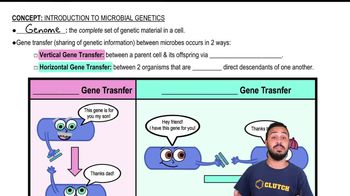
Vertical gene transfer is the flow of genetic information from one generation to the next.
Topoisomerase and gyrase relax strands, helicase separates strands, and DNA polymerase synthesizes new DNA strands.
Discontinuously, creating Okazaki fragments that are later joined by DNA polymerase and DNA ligase.
Ribosomal RNA (rRNA), transfer RNA (tRNA), and messenger RNA (mRNA).
Transcription is the synthesis of a complementary mRNA strand from a DNA template by RNA polymerase.
Codons are groups of three mRNA nucleotides that code for specific amino acids during protein synthesis.
An operon that is normally off but can be turned on by an inducer, e.g., the lac operon in E. coli.
It is normally on but can be turned off by a corepressor activating the repressor, e.g., the trp operon.
A permanent change in the base sequence of DNA that may be neutral, beneficial, or harmful.
Insertion or deletion of nucleotides that shifts the reading frame, altering many downstream amino acids.
Ionizing radiation (X-rays, gamma rays) and UV radiation, which causes thymine dimers.
Using photolyases (light repair) and nucleotide excision repair enzymes.
Transfer of genes between cells of the same generation, involving donor and recipient cells.
Self-replicating circular DNA molecules in bacteria that may carry genes for antibiotic resistance or pathogenicity.
Transfer of plasmids between bacteria via direct cell-to-cell contact, often using sex pili in Gram-negative bacteria.
Uptake of naked DNA from the environment by a bacterial cell.
Transfer of bacterial DNA from donor to recipient via a bacteriophage.