Skip to main content
Microbiology
My Course
Learn
Exam Prep
AI Tutor
Study Guides
Textbook Solutions
Flashcards
Explore
Try the app
My Course
Learn
Exam Prep
AI Tutor
Study Guides
Textbook Solutions
Flashcards
Explore
Try the app
Back
Microbiology: A Brief History and Key Concepts
You can tap to flip the card.
Who is considered the Father of Microbiology?
You can tap to flip the card.
👆
Who is considered the Father of Microbiology?
Antoni van Leeuwenhoek, who made the first simple microscope and first observed microorganisms.
Track progress
Control buttons has been changed to "navigation" mode.
1/29
Recommended videos
Guided course
03:55
Discovering Microorganisms
12996
views
430
rank
Guided course
07:27
Introduction to Microbiology
24155
views
977
rank
5
comments
Guided course
1:29
Introduction to Microbiology Channel
23314
views
598
rank
2
comments
Terms in this set (29)
Hide definitions
Who is considered the Father of Microbiology?
Antoni van Leeuwenhoek, who made the first simple microscope and first observed microorganisms.
What are microorganisms also known as?
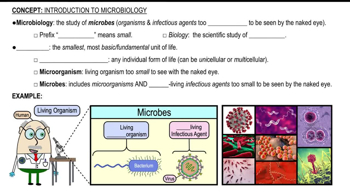
Microbes; life forms too small to be seen without a microscope.
What are the two main cell types used to classify all living organisms?
Eukaryotes
(cells with a nucleus) and
prokaryotes
(cells without a nucleus).
What distinguishes bacteria from archaea?
Bacteria have cell walls made of peptidoglycan; archaea lack peptidoglycan and have different cell wall polymers.
What are Koch's postulates?
Four criteria to prove a microbe causes a disease: presence in diseased hosts, isolation, disease reproduction in healthy hosts, and re-isolation.
What is spontaneous generation?
The disproven theory that living organisms can arise from nonliving matter.
How did Pasteur disprove spontaneous generation?
Using swan-necked flasks that allowed air but trapped microbes, showing sterile broth remained microbe-free unless contaminated.
What is fermentation and who studied its microbial causes?
Microbial conversion of sugars to alcohol or acids; studied by Louis Pasteur.
What is pasteurization?
The use of heat to kill pathogens and reduce spoilage microbes in food and beverages.
What is the germ theory of disease?
The concept that microorganisms are responsible for infectious diseases.
Who developed the Gram stain and why is it important?
Hans Christian Gram; it differentiates bacteria into Gram-positive and Gram-negative for identification.
What hygiene practice did Ignaz Semmelweis introduce?
Hand washing with chlorinated lime water to prevent puerperal fever.
What did Joseph Lister contribute to microbiology?
Introduced antiseptic surgery using phenol to reduce infections.
What is epidemiology?
The study of the occurrence, distribution, and spread of disease in humans.
What is immunization and who pioneered it?
The process of inducing immunity to disease; pioneered by Edward Jenner using cowpox to prevent smallpox.
What is chemotherapy in microbiology?
The use of chemicals to kill pathogens without harming the host, initiated by Paul Ehrlich.
What is biochemistry's role in microbiology?
Study of metabolism and chemical reactions in microbes, foundational for understanding life processes.
What is molecular biology's focus in microbiology?
Understanding gene function, genome sequencing, and genetic engineering in microbes.
What is recombinant DNA technology?
Manipulation of genes in organisms for practical applications like pest-resistant crops and gene therapy.
What role do microbes play in the environment?
They recycle nutrients, decompose organic matter, and can detoxify pollutants through bioremediation.
What is quorum sensing?
Microbial communication process that coordinates group behaviors in communities.
What are health care–associated infections (HAI)?
Infections acquired in health care settings, highlighting the need for hygiene and infection control.
Why are viruses unique among microbes?
They are acellular obligatory parasites, only visible with electron microscopes.
What is the significance of Florence Nightingale in microbiology?
She introduced hygienic and antiseptic nursing practices and founded modern nursing.
What is the scientific method in microbiology?
A process of observation, hypothesis, experimentation, and conclusion to validate scientific questions.
What is the importance of Koch's laboratory techniques?
They enabled isolation, staining, culturing, and identification of bacteria.
What is the difference between fungi and protozoa?
Fungi are eukaryotes with cell walls that absorb nutrients; protozoa are single-celled eukaryotes often motile and animal-like.
What is the role of enzymes in fermentation?
Enzymes are proteins produced by cells that catalyze chemical reactions like fermentation.
What challenges exist in applying Koch's postulates?
Some diseases are non-infectious, ethical issues prevent testing in humans, and some microbes are present in healthy carriers.
 BackBack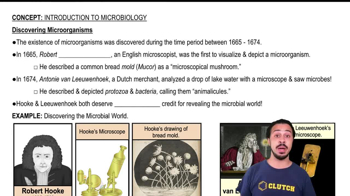
 03:55
03:55