Back

Microbiology: Bacterial Growth and Culture Methods

Control buttons has been changed to "navigation" mode.
1/20

  • What are the five temperature groups of bacteria and their characteristics?

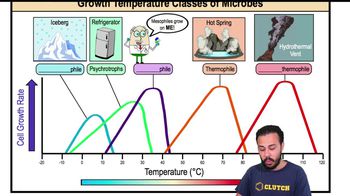
    • Psychrophiles: Favor 15°C, die at room temp, little threat to humans.
    • Psychrotrophs: Best at 20-30°C, cause food spoilage.
    • Mesophiles: Best at 37°C (host temp), include pathogens.
    • Thermophiles: Best at 50-60°C, found in hot springs and compost.
    • Hyperthermophiles: Best at 80°C, found at sea vents.
  • What is the 'Danger Zone' temperature range for bacterial growth?

    The Danger Zone is between 15°C and 50°C (60°F to 130°F), where bacteria grow rapidly.
  • How does pH influence bacterial growth?

    Most bacteria grow best at pH 6.5-7.5, while yeasts prefer pH 5-6.
  • What effect does osmotic pressure have on microbial growth?

    High salt or sugar creates a hypertonic environment causing plasmolysis, where water exits the cell, inhibiting growth.
  • What are the four major chemical elements required in large amounts for microbial growth and their uses?

    • Water: 80% of cytoplasm, medium for dissolved substances.
    • Carbon: 50% of dry weight, backbone of organic molecules.
    • Nitrogen: Used to build proteins and DNA, and generate energy.
    • Phosphorus: Incorporated into cell membranes.
  • What role do trace elements play in microbial growth?

    Trace elements act as inorganic cofactors that bind to proteins and activate enzymes, serving mainly as catalysts.
  • How do different bacteria utilize oxygen?

    • Obligate aerobes: Need oxygen.
    • Facultative anaerobes: Use oxygen or fermentation.
    • Obligate anaerobes: Harmed by oxygen, no protective enzymes.
    • Aerotolerant anaerobes: Don't use oxygen but tolerate it.
    • Microaerophiles: Require low oxygen levels.
  • What enzymes protect bacteria from toxic oxygen forms?

    Protective enzymes include superoxide dismutase (SOD), catalase, and peroxidase which detoxify reactive oxygen species.
  • What is a biofilm and why is it important?

    A biofilm is a slime or hydrogel layer of microbes adhering to surfaces, highly resistant to microbicides and involved in 70% of infections.
  • What is agar and its role in microbiology?

    Agar is a complex polysaccharide used as a solidifying agent in culture media; it liquefies at 100°C and solidifies at 40°C.
  • What is the difference between complex media and chemically-defined media?

    Complex media: Exact composition unknown, used for nonfastidious microbes.
    Chemically-defined media: Exact chemical composition known.
  • What are selective and differential media?

    Selective media: Suppress unwanted microbes to select certain ones.
    Differential media: Distinguish microbes based on visible changes.
  • What is reducing media used for?

    Reducing media lowers oxygen levels and increases CO2 to support growth of anaerobic bacteria.
  • How are pure cultures obtained using the streak plate method?

    Microbes are spread on agar plates to isolate single colonies, each arising from one cell or spore.
  • What methods are used to preserve microbial cultures?

    Preservation methods include adding glycerol and deep freezing (-50°C to -95°C) or lyophilization (freeze-drying).
  • What is binary fission in bacterial growth?

    Binary fission is the process where one bacterial cell divides into two identical daughter cells.
  • What is generation time in bacteria?

    Generation time is the time required for a bacterial cell to divide; for example, E. coli divides every 20 minutes.
  • Describe the four phases of bacterial growth.

    • Lag phase: Metabolic activity, no division.
    • Log phase: Exponential growth, most sensitive to antibiotics.
    • Stationary phase: Nutrient depletion slows growth.
    • Death phase: Population declines due to toxic waste.
  • What are four methods to quantify bacterial growth?

    • Plating method with dilutions.
    • Filtration method for water samples.
    • Direct microscopic count using hemocytometer.
    • Turbidity measurement with spectrophotometer.
  • Which bacterial quantification methods require time, media, and equipment?

    Plating and filtration methods require incubation time, culture media, and lab equipment.