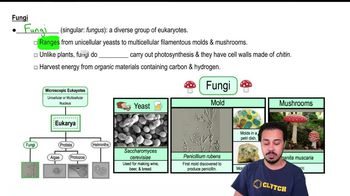
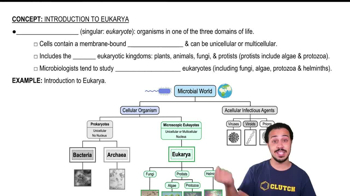
Fungi are chemoheterotrophic eukaryotes that decompose organic matter, have cell walls containing glucans, mannans, and chitin, and reproduce via sexual and asexual spores.
How do fungi differ from bacteria in cell structure?
Fungi are eukaryotic with sterols in their membranes and cell walls made of glucans, mannans, and chitin, while bacteria are prokaryotic with peptidoglycan cell walls and lack sterols except Mycoplasma.
What are septate and coenocytic hyphae?
Septate hyphae contain cross-walls (septa) dividing cells, while coenocytic hyphae lack septa and consist of a continuous cytoplasmic mass with many nuclei.
What is the difference between vegetative and aerial hyphae?
Vegetative hyphae obtain nutrients, while aerial hyphae are involved in reproduction, often producing spores.
Describe the characteristics of yeasts.
Yeasts are unicellular, nonfilamentous fungi that reproduce asexually by budding (uneven division) or fission (even division).
What is fungal dimorphism?
Dimorphic fungi grow as yeast-like forms at 37°C and mold-like forms at 25°C, adapting to environmental conditions.
How do fungi reproduce asexually?
Asexual spores are produced via mitosis and include conidiospores, arthroconidia, blastoconidia, chlamydoconidia, and sporangiospores.
What are the three phases of sexual reproduction in fungi?
Plasmogamy (fusion of cytoplasm), karyogamy (fusion of nuclei), and meiosis (formation of haploid sexual spores).
What are the nutritional adaptations of fungi?
Fungi grow best at pH 5, tolerate high sugar and salt concentrations, resist osmotic pressure, grow in low moisture, and metabolize complex carbohydrates.
Name the four medically important fungal phyla.
Zygomycota, Microsporidia, Ascomycota, and Basidiomycota.
What distinguishes Zygomycota fungi?
They have coenocytic hyphae, produce asexual sporangiospores, and sexual zygospores formed by fusion of nuclei.
What are microsporidia?
Obligate intracellular parasites with no mitochondria, no observed sexual reproduction, and produce nonmotile spores.
What are the characteristics of Ascomycota fungi?
Sac fungi with septate hyphae, produce sexual ascospores in asci, and asexual conidiospores; some are anamorphic (lost sexual reproduction).
What defines Basidiomycota fungi?
Club fungi with septate hyphae, produce sexual basidiospores externally on basidia, and asexual conidiospores.
What are lichens?
Mutualistic associations between a fungus and a green alga or cyanobacterium, forming crustose, foliose, or fruticose thalli.
What roles do the fungus and alga play in lichens?
The alga produces carbohydrates via photosynthesis; the fungus provides structure and holdfasts.
What are the defining characteristics of algae?
Unicellular or filamentous photoautotrophs lacking roots, stems, and leaves, mostly aquatic, requiring water for growth and reproduction.
Name the six selected phyla of algae and a key feature of each.
Brown algae (cellulose and alginic acid), Red algae (phycobiliproteins), Green algae (chlorophyll a and b), Diatoms (silica cell walls), Dinoflagellates (cellulose in membrane), Oomycota (water molds, cellulose walls).
What are the ecological roles of algae?
Fix CO2 into organic molecules, produce 80% of Earth's oxygen, cause algal blooms, produce oils, and serve as symbionts.
What are protozoa and their key features?
Unicellular eukaryotes with animal-like nutrition, complex life cycles, reproduce asexually by fission or schizogony, and sexually by conjugation.
What are the medically important protozoan groups?
Diplomonads, Parabasalids, Euglenozoa, Amebae, Apicomplexa, and Ciliates.
Describe the life cycle of Plasmodium (malaria parasite).
Sexual reproduction occurs in Anopheles mosquito; sporozoites infect liver cells, merozoites infect red blood cells causing cycles of rupture and infection.
What are slime molds and their types?
Slime molds are amoeboid protists; cellular slime molds aggregate to form spores, plasmodial slime molds are multinucleate masses moving by cytoplasmic streaming.
What are helminths and their two main phyla?
Multicellular parasitic worms; Platyhelminthes (flatworms) and Nematoda (roundworms).
What are the characteristics of platyhelminths?
Flat, leaf-shaped or segmented worms with suckers, absorb food through cuticle, include trematodes (flukes) and cestodes (tapeworms).
What distinguishes nematodes?
Cylindrical roundworms with complete digestive systems, dioecious, some have infective eggs or larvae stages.
What are arthropods as vectors?
Animals with segmented bodies and jointed legs that transmit pathogens mechanically or biologically; include ticks, mosquitoes, lice, fleas, and flies.
 Back
Back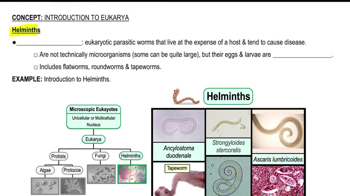
 01:56
01:56