 Back
BackMicrobiology: Key Concepts and History
 04:27
04:27
Terms in this set (26)
What are microorganisms?
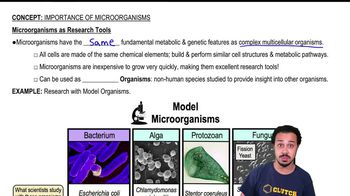
Microorganisms are organisms too small to be seen with the unaided eye, including bacteria, fungi, protozoa, microscopic algae, viruses, and prions.
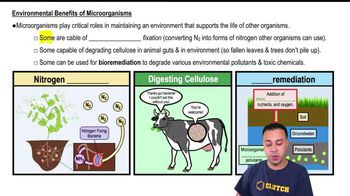
Microbes decompose organic waste, incorporate nitrogen gas into organic compounds, and generate oxygen by photosynthesis.
The microbiome is the group of microbes that live stably on or in the human body, helping maintain health and preventing pathogenic growth.
Normal microbiota are microbes permanently colonizing the body; transient microbiota colonize temporarily.
Carolus Linnaeus established scientific nomenclature, using two names: genus (capitalized) and specific epithet (lowercase), both italicized or underlined.
The three domains are Bacteria, Archaea, and Eukarya.
Bacteria are unicellular prokaryotes with peptidoglycan cell walls, reproduce by binary fission, and may have flagella for movement.
Archaea are prokaryotes lacking peptidoglycan in their cell walls, often live in extreme environments, and are not known to cause human disease.
Fungi are eukaryotes with chitin cell walls; yeasts are unicellular, molds are multicellular with hyphae.
Protozoa are eukaryotes that absorb or ingest organic chemicals, may be motile, and reproduce sexually or asexually.
Viruses are acellular, consist of DNA or RNA core with a protein coat, and replicate only inside living host cells.
Spontaneous generation is the idea life arises from nonliving matter; biogenesis states living cells arise only from preexisting living cells.
Louis Pasteur disproved spontaneous generation using S-shaped flasks that allowed air but trapped microbes, showing microbes come from the environment.
Fermentation is microbial conversion of sugar to alcohol without air, demonstrated by Louis Pasteur.
Pasteurization is heating a liquid briefly to kill harmful bacteria without evaporating alcohol, developed by Pasteur.
Experimental steps to prove a specific microbe causes a specific disease, developed by Robert Koch.
Vaccination is inoculation to produce immunity, pioneered by Edward Jenner using cowpox to protect against smallpox.
Chemotherapy is treatment of disease with chemicals, including synthetic drugs and antibiotics.
Alexander Fleming discovered penicillin, the first antibiotic, produced by Penicillium fungus.
Microbial resistance is the ability of microbes to withstand antimicrobial drugs, complicating treatment.
Molecular genetics studies how microbes inherit traits and how genetic information is carried in DNA molecules.
Recombinant DNA is DNA made from two different sources, enabling microbes to produce proteins like human hormones.
Microbes recycle vital elements, treat sewage, clean pollutants (bioremediation), and control insect pests.
Biofilms are complex microbial communities attached to surfaces, which can be beneficial or harmful.
EIDs are new or increasing diseases caused by pathogens, influenced by factors like antibiotic resistance and human activity.
Examples include COVID-19, Monkeypox, Zika virus, H1N1 influenza, Ebola, and antibiotic-resistant infections like MRSA.