Back

Microbiology Key Concepts and Review

Control buttons has been changed to "navigation" mode.
1/30
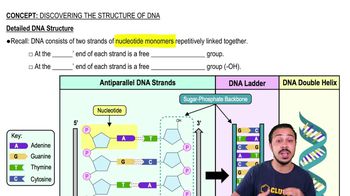
  • What are the subunits that make up DNA?

    DNA is composed of nucleotides, each containing a sugar, a phosphate group, and a nitrogenous base (A, T, C, or G).
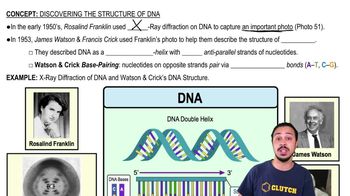
  • What does it mean that DNA strands are antiparallel?

    DNA strands run in opposite directions: one strand runs 5′ to 3′, the other 3′ to 5′.
  • What roles do mRNA, tRNA, and rRNA play in protein synthesis?

    mRNA carries genetic code from DNA to ribosomes, tRNA brings amino acids to ribosomes, and rRNA forms ribosome structure and catalyzes protein synthesis.
  • What is semiconservative replication?

    Each new DNA molecule contains one original strand and one newly synthesized strand.
  • In which direction is DNA synthesized?

    DNA polymerase synthesizes new DNA strands in the 5′ to 3′ direction.
  • What enzymes are involved in DNA replication and their roles?

    Helicase unwinds DNA, DNA polymerase synthesizes new strands, and ligase seals gaps between fragments.
  • What is the role of a promoter in transcription?

    A promoter is a DNA sequence where RNA polymerase binds to initiate transcription.
  • What is the significance of the start codon AUG in translation?

    AUG signals the start of translation and codes for the amino acid methionine.
  • What are the types of mutations and their effects?

    Silent mutations cause no amino acid change; missense mutations change one amino acid; nonsense mutations introduce a stop codon; frameshift mutations result from insertions or deletions altering the reading frame.
  • How do bacteria exchange genetic material?

    Through horizontal gene transfer: transformation (uptake of DNA), conjugation (direct transfer via pilus), and transduction (phage-mediated transfer).
  • What is sterilization?

    The complete destruction or removal of all viable microorganisms, including spores.
  • What is the difference between disinfection and antisepsis?

    Disinfection destroys most microbes on inanimate objects; antisepsis reduces microbes on living tissue.
  • What are mesophiles?

    Microbes that grow best at moderate temperatures, typically 20–45°C.
  • What is the primary mechanism by which alcohol-based hand sanitizers kill microbes?

    They disrupt microbial membranes and denature proteins.
  • What is the difference between bactericidal and bacteriostatic agents?

    Bactericidal agents kill bacteria; bacteriostatic agents inhibit bacterial growth.
  • What is microbial metabolism?

    All biochemical reactions in a microorganism, including catabolism (energy release) and anabolism (biosynthesis).
  • What is the role of enzymes in metabolism?

    Enzymes are biological catalysts that speed up reactions without being consumed.
  • What happens in a redox reaction?

    One molecule loses electrons (oxidation) and another gains electrons (reduction).
  • What is ATP and its role?

    ATP is the energy currency of the cell, providing energy for metabolic processes.
  • What are the end products of glycolysis?

    Two pyruvate molecules, 2 ATP, and 2 NADH molecules per glucose.
  • What is fermentation?

    An anaerobic process regenerating NAD+ by transferring electrons from NADH to organic molecules, producing less ATP than respiration.
  • What is epidemiology?

    The study of disease spread, patterns, causes, and effects in populations.
  • What are the five stages of infectious disease?

    Incubation, prodromal, acute, decline, and convalescent stages.
  • What is a reservoir in disease transmission?

    A living or non-living source where a pathogen normally lives and multiplies.
  • What is the epidemiological triangle?

    The interaction of host, agent, and environment in disease spread.
  • What is a zoonotic infection?

    An infection transmitted from animals to humans.
  • What is a healthcare-associated infection (HAI)?

    An infection acquired in a healthcare setting, often due to improper aseptic technique.
  • What are virulence factors?

    Pathogen traits like adhesins, toxins, and immune evasion mechanisms that enable infection.
  • How does a capsule help a pathogen?

    It helps evade the host immune system by preventing phagocytosis.
  • What is the infectious dose (ID50)?

    The number of organisms required to cause infection in 50% of exposed hosts.